
Table des matières
ToggleUlugh Beg Observatory: A Historic Center of Astronomy in Samarkand
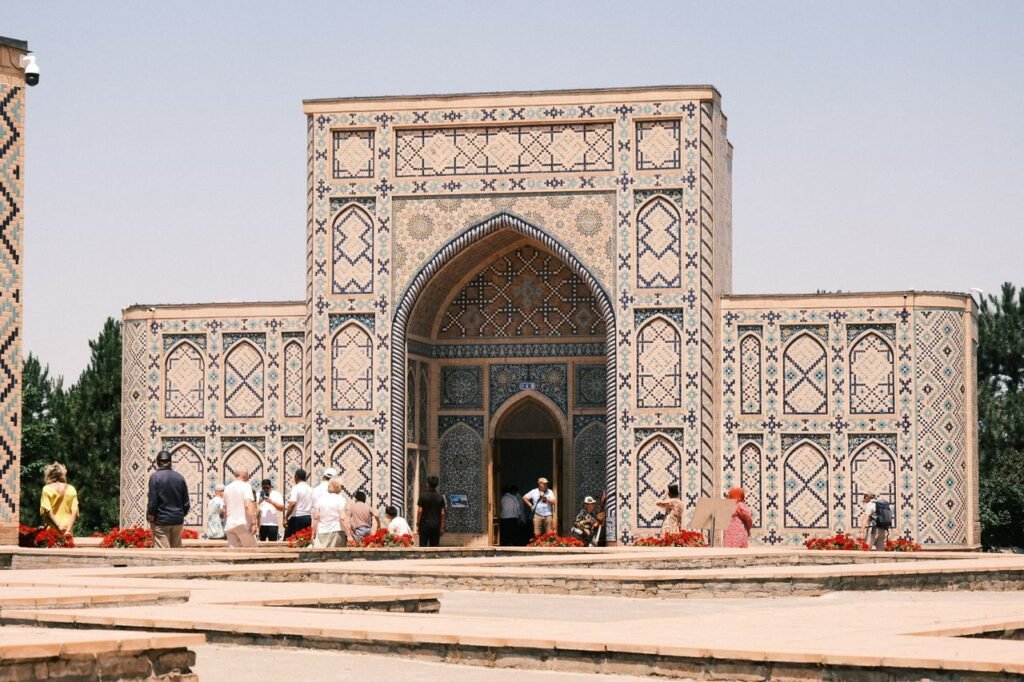
The Ulugh Beg Observatory is one of the most remarkable historical sights in Samarcande, Uzbekistan. Built during the 15th century, it represents an extraordinary period in the history of science, when scholars in Central Asia made important advances in astronomy and mathematics. The observatory is closely associated with Ulugh Beg, a Timurid ruler and renowned astronomer who helped establish Samarkand as a major center of scientific learning.
Although much of the original structure has disappeared, the surviving remains and nearby museum offer visitors a fascinating look into medieval astronomy. The site is an excellent addition to a Samarkand itinerary, particularly for travelers interested in history, science, Islamic scholarship, and the intellectual achievements of the Timurid era.
History of Ulugh Beg Observatory
Ulugh Beg and His Scientific Vision
Ulugh Beg was born in 1394 and was the grandson of Amir Timur, the founder of the Timurid Empire. Unlike many rulers remembered primarily for military campaigns, Ulugh Beg became especially famous for his passion for mathematics, astronomy, and education.
During his rule, Samarkand developed into an important intellectual center. Ulugh Beg supported scholars, mathematicians, and astronomers, creating an environment where scientific observation and calculation could flourish. His work reflected the broader scholarly traditions of the medieval Islamic world, in which astronomers studied the movements of celestial bodies and refined mathematical techniques.
Construction of the Observatory
The observatory was established in the 1420s on a hill north of central Samarkand. Its design reflected the ambitious scientific goals of Ulugh Beg and his colleagues. Rather than relying exclusively on inherited astronomical tables, scholars used carefully designed instruments to observe the sky and calculate the positions of stars and planets.
The most impressive feature was a vast astronomical instrument built into the ground. Its scale allowed astronomers to make precise measurements of celestial angles and improve their understanding of the heavens.
The observatory became one of the most important scientific institutions of its time, attracting scholars whose work influenced astronomical studies far beyond Central Asia.
Scientific Achievements
Ulugh Beg and the scholars associated with his observatory produced an influential star catalogue that recorded the positions of more than a thousand stars. Their calculations were remarkable for their accuracy, especially considering the instruments and methods available in the 15th century.
The research carried out in Samarkand contributed to the development of astronomical tables used by later generations. The observatory’s legacy demonstrates that medieval Central Asia was not only a crossroads of trade and culture but also a center of advanced scientific research.
Decline and Rediscovery
After Ulugh Beg’s death in 1449, the observatory gradually fell into decline. Its scientific community dispersed, and the building eventually disappeared beneath the surrounding landscape. For centuries, little remained visible above ground to indicate the importance of the original institution.
In the early 20th century, archaeological investigations led by Vasily Vyatkin identified the site and uncovered significant remains of its main astronomical instrument. These discoveries helped establish the location’s historical importance and brought renewed attention to Ulugh Beg’s contribution to science.
Today, the observatory is preserved as a historical attraction, with archaeological remains and a museum explaining its scientific achievements.
What to See at Ulugh Beg Observatory
1. The Remains of the Giant Sextant
The most important feature of the site is the surviving section of the enormous astronomical instrument used to measure the altitude of celestial bodies. Commonly described as a giant sextant, it formed part of a much larger structure built into the hillside.
The exposed curved section gives visitors an idea of the scale and ambition of the original observatory. Its size illustrates how medieval astronomers used large, carefully constructed instruments to improve measurement accuracy.
Although only part of the original installation survives, it remains the defining feature of the site.
2. Ulugh Beg Observatory Museum
The museum near the archaeological remains provides context for understanding the observatory and its place in the history of science. Exhibits explain Ulugh Beg’s life, the development of medieval astronomy, and the work of the scholars who studied the sky in Samarkand.
Visitors can learn about astronomical instruments, star catalogues, and the mathematical methods used to calculate the positions of celestial objects. Displays and illustrations help explain how the original observatory functioned and why its research was so influential.
The museum is particularly useful for visitors who want to understand the scientific significance of the site rather than simply view the remaining structure.
3. The Monument to Ulugh Beg
A monument honoring Ulugh Beg stands in the observatory area. It commemorates his achievements as a ruler, scholar, and patron of scientific learning.
The monument offers an opportunity to reflect on his unusual legacy. While he governed a powerful dynasty, his lasting reputation rests largely on his intellectual interests and the scientific work supported under his leadership.
4. Historical Displays and Astronomical Illustrations
The site’s exhibits introduce visitors to the methods used by medieval astronomers to study the movement of stars and planets. They also help explain the importance of careful observation, mathematical calculation, and the recording of astronomical data.
These displays make the observatory accessible to travelers who may not have a background in science. They also highlight the connection between astronomy, mathematics, education, and cultural development in Timurid Samarkand.
5. The Observatory Grounds
The surrounding grounds provide a quieter historical setting away from some of Samarkand’s busiest monuments. Walking around the site allows visitors to appreciate its location and imagine the work that once took place here.
The atmosphere is different from the richly decorated madrasas and mausoleums in the city center. At the observatory, the main attraction is the story of scientific discovery and the physical remains of a pioneering research center.
Why Ulugh Beg Observatory Is Important
Ulugh Beg Observatory occupies a special place in the history of astronomy because it demonstrates the sophistication of scientific research in Central Asia during the 15th century.
Its importance can be understood through several key contributions:
Astronomical observation: The observatory used large instruments to make detailed measurements of celestial bodies.
Star cataloguing: Ulugh Beg and his colleagues compiled an influential catalogue of stellar positions.
Mathematical research: Their work combined observation with advanced mathematical calculations.
Scholarly collaboration: The observatory formed part of a wider intellectual environment supported by Ulugh Beg.
Scientific legacy: Its findings circulated among later scholars and contributed to the continuing development of astronomy.
The observatory is a reminder that scientific innovation has emerged from many different regions and cultures throughout history.
Architecture and Design of the Observatory
Unlike the monumental religious buildings that dominate Samarkand’s historic center, the Ulugh Beg Observatory was designed primarily for scientific observation. Its layout was shaped by the need to measure the sky accurately rather than to create a richly decorated public monument.
The observatory’s principal instrument was integrated into a substantial structure aligned to support astronomical measurements. The large scale of the installation helped astronomers determine celestial angles with considerable precision.
The surviving remains provide only a partial picture of the original complex. Nevertheless, archaeological evidence and historical accounts help researchers reconstruct its basic function and understand the technical challenges involved in its construction.
The observatory illustrates how architecture could serve scientific purposes, transforming a building into a practical instrument for studying the universe.
Practical Visitor Information
Lieu
Ulugh Beg Observatory is located in the northeastern part of Samarkand, Uzbekistan, away from the main concentration of monuments around Registan Square. It can be reached by taxi or local transport from the city center.
Opening Hours
Opening hours may vary depending on the season, public holidays, and local arrangements. Check current details before visiting, particularly if you plan to combine the observatory with several other sights on the same day.
Entrance Fees
Admission may be charged for the observatory grounds and museum. Ticket prices and payment arrangements can change, so confirm the current fee locally before your visit.
How Much Time to Spend
Most visitors should allow approximately 45 minutes to 1.5 hours to explore the archaeological remains, view the museum exhibits, and learn about Ulugh Beg’s scientific work.
Travelers with a strong interest in astronomy or Central Asian history may want to spend longer reading the displays and exploring the site’s background.
Meilleure période pour visiter
Spring and autumn are generally comfortable seasons for sightseeing in Samarkand, with temperatures often more suitable for walking between outdoor attractions. Summer visits can be hot, so an earlier visit may be more comfortable.
The observatory can be visited throughout the year, depending on local opening arrangements and weather conditions.
Que prendre avec soi
Comfortable walking shoes for the outdoor grounds.
Drinking water during warmer months.
A camera for the archaeological remains and monument.
Sun protection in summer.
Enough time to read the museum displays and understand the site’s history.
Best Places to Visit Near Ulugh Beg Observatory
The observatory can be combined with several other important sights in Samarkand. Depending on your transport and schedule, you can visit it alongside the city’s celebrated architectural monuments.
Place du Régistan
Place du Régistan is the best-known landmark in Samarkand, surrounded by three monumental madrasas decorated with intricate tilework, mosaics, and elaborate façades. It offers a striking contrast with the observatory: one represents the grandeur of Timurid-era urban architecture, while the other reflects the region’s scientific achievements.
Shah-i-Zinda
Shah-i-Zinda is a remarkable avenue of mausoleums known for its colorful glazed tiles and detailed architectural decoration. Its historic buildings provide a deeper understanding of the artistic traditions that developed in Samarkand.
Mosquée Bibi-Khanym
Mosquée Bibi-Khanym is one of the city’s most impressive historical religious structures. Its monumental scale and surviving decorative details reflect the ambitions of the Timurid period.
Mausolée Gur-e-Amir
Gur-e-Amir is the mausoleum associated with Amir Timur and several members of the Timurid dynasty. Its blue dome and richly decorated interior make it one of Samarkand’s essential historical attractions.
Amir Timur Statue and City Center
The central area of Samarkand offers additional opportunities to explore the city’s modern streets, public spaces, shops, and cafés. It is a convenient place to take a break between visits to the city’s historic monuments.
Suggested Itinerary Including Ulugh Beg Observatory
If you have one full day to explore Samarkand, consider starting with the city’s most famous architectural landmarks and visiting the observatory as part of a wider historical tour.
Morning: Explore Registan Square and its surrounding historic streets.
Late morning: Visit Bibi-Khanym Mosque and the nearby areas of the old city.
Afternoon: Explore Shah-i-Zinda, then travel to Ulugh Beg Observatory to learn about the scientific achievements of medieval Samarkand.
Late afternoon: Finish with Gur-e-Amir Mausoleum or return to the city center for a relaxed walk and dinner.
This itinerary can be adjusted according to opening hours, transport arrangements, and how much time you want to spend at each location.


