
Table des matières
ToggleCentral Mosque of Imam Sarakhsi in Bishkek, Kyrgyzstan
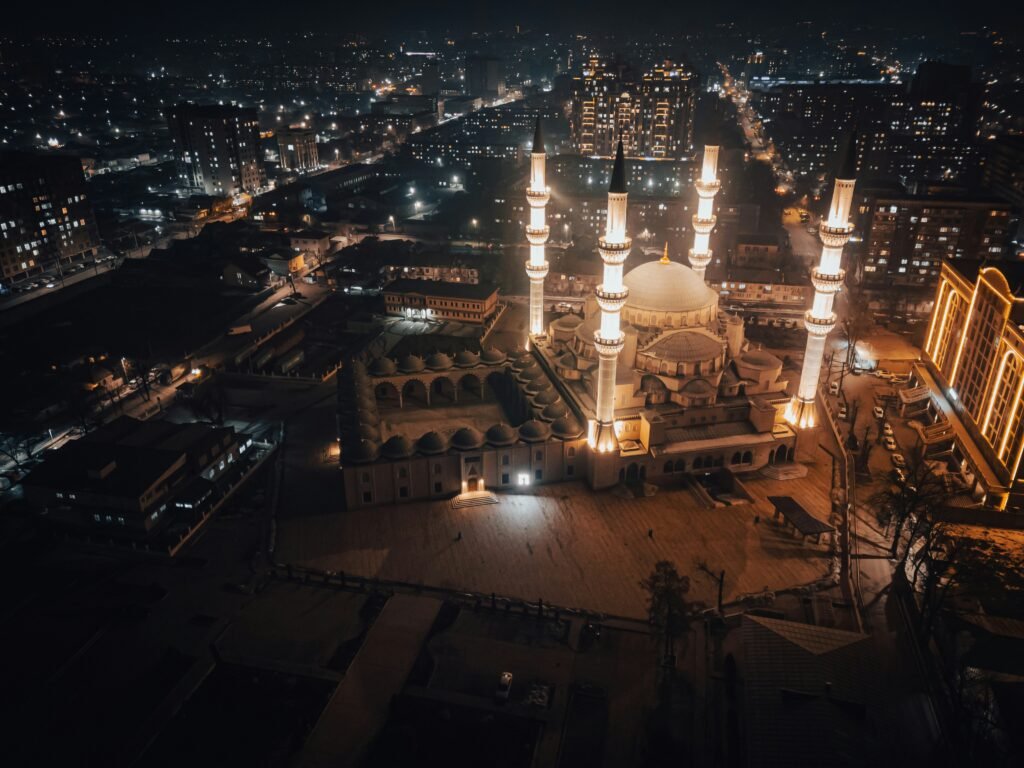
The Central Mosque of Imam Sarakhsi, commonly known as the Bishkek Central Mosque, is one of the most prominent modern Islamic landmarks in Bishkek. Built in an Ottoman revival style, the mosque features a large central dome, four tall minarets, an expansive courtyard, and richly decorated interiors.
Construction began in 2012 and the mosque was officially inaugurated on 2 September 2018. It was built with support from Türkiye’s Diyanet and named after the 11th-century Central Asian Islamic scholar and jurist Imam Muhammad al-Sarakhsi.
About the Central Mosque
The mosque stands on Gogol Street near Jibek Jolu Avenue, east of Bishkek’s historic center.
It is both an active place of worship and an important architectural landmark. Its design draws heavily on Ottoman mosque architecture, giving it a distinctive appearance within Bishkek’s predominantly Soviet and post-Soviet urban landscape.
At a Glance
Information | Details |
Type of Place | Architecture Complex |
Official name | Central Mosque of Imam Sarakhsi |
Common name | Bishkek Central Mosque |
Location | Bishkek, Kirghizstan |
Adresse | Gogol Street, near Jibek Jolu Avenue |
Construction | 2012–2018 |
Opened | 2 September 2018 |
Architectural style | Ottoman revival |
Minarets | 4 |
Main features | Central dome, courtyard, minarets, decorated interior |
Recommended time | 30–60 minutes |
Where Is the Central Mosque?
The mosque is located on Gogol Street, near Jibek Jolu Avenue, approximately 2 km northeast of Ala-Too Square.
Its location makes it relatively easy to combine with other central Bishkek sights.
Architecture of the Central Mosque
Ottoman Revival Design
The mosque was designed in an Ottoman-inspired architectural style.
Its large central dome is surrounded by smaller domed elements, while four slender minarets rise from the corners of the complex. The overall composition is strongly reminiscent of major Ottoman-era and Ottoman-revival mosques in Türkiye.
Four Minarets
The mosque has four tall minarets, each incorporating multiple balconies.
The minarets are among the most recognizable elements of the Bishkek skyline around the mosque. Some sources give their height as approximately 70 meters.
Central Dome
The large central dome dominates the exterior of the mosque and the main prayer hall.
The combination of the central dome, smaller domes and four minarets creates the mosque’s characteristic Ottoman appearance.
Courtyard
The mosque includes a large open courtyard surrounded by arcaded structures.
A traditional ablution fountain forms part of the courtyard design.
Interior Decoration
Inside, the mosque features Islamic decorative elements, including patterned tilework, chandeliers, ornamental details and a large prayer space.
The interior continues the Ottoman-inspired architectural language used on the exterior.
History of the Central Mosque
Construction of the present mosque began in 2012.
The project was developed with Turkish support and was intended to provide a much larger mosque for Bishkek’s growing Muslim community.
The mosque was officially inaugurated on 2 September 2018. The opening ceremony was attended by Kyrgyz President Sooronbay Jeenbekov and Turkish President Recep Tayyip Erdoğan.
The mosque was named after Imam Muhammad al-Sarakhsi, a prominent Islamic scholar and jurist from Central Asia.
Who Was Imam al-Sarakhsi?
Muhammad al-Sarakhsi was an influential Islamic scholar and jurist associated with the Hanafi tradition.
He lived during the 11th century and is particularly associated with Central Asian Islamic scholarship.
The mosque’s name therefore connects a modern Bishkek landmark with the region’s medieval Islamic intellectual heritage. Kyrgyz Express Post notes that al-Sarakhsi died in Uzgen, where his mausoleum is located.
The Central Mosque and Turkish Architecture
The mosque is one of the clearest examples of Ottoman-inspired architecture in modern Bishkek.
Its design reflects the architectural tradition associated with Turkish imperial mosques, while its location and function place it firmly within contemporary Kyrgyzstan.
The mosque was funded and constructed with significant Turkish involvement, making it an architectural example of the cultural connections between Kyrgyzstan and Türkiye.
How to Visit the Central Mosque
The mosque is an active religious institution rather than a conventional museum.
Visitors should therefore treat the site primarily as a place of worship and observe appropriate religious etiquette.
When entering:
- dress modestly
- avoid disturbing people who are praying
- follow any instructions from mosque staff
- ask before photographing people
- observe any restrictions on photography
- remove shoes where required
- avoid visiting restricted prayer areas unless permitted
Women may be asked to cover their hair or wear appropriate clothing depending on the area being visited.
Because visitor arrangements can change, current access should be confirmed locally rather than relying on permanently published opening hours.
Best Time to Visit
The mosque can be visited throughout the year, subject to access and religious activities.
For sightseeing, daylight hours are useful for seeing the exterior architecture and courtyard.
The mosque is particularly striking after dark when its exterior illumination is visible.
Visitors should be especially respectful around Friday prayers and major Islamic holidays, when the mosque serves large numbers of worshippers.
Practical Information
- Entrance: The mosque is an active place of worship.
- Visit duration: Around 30–60 minutes for architectural sightseeing.
- Dress: Modest clothing is appropriate.
- Photography: Ask before photographing people or restricted areas.
- Prayer times: Visitor access can be affected by religious services.
- Accessibility: Current access arrangements should be checked locally.
- Transport: The mosque is accessible by taxi and public transport along Jibek Jolu Avenue.
Current map listings show the mosque as an active religious site with daily access, but published hours should be treated as changeable rather than fixed tourism information.
Central Mosque and Bishkek’s Historic Center
The mosque is close enough to several major Bishkek sights to form part of a city sightseeing route.
A possible route is:
Ala-Too Square to National Historical Museum to Oak Park to Open-Air Sculpture Museum to Central Mosque
This gives visitors a combination of Soviet-era urban architecture, museums, parks, sculpture and modern Islamic architecture.
Central Mosque and the Old Central Mosque
The name can cause confusion because Bishkek has historically had another mosque known as the Central Mosque.
The older mosque is located on Gogol Street near Moskovskaya Street and dates to the late 20th century in its present form. The newer and much larger mosque near Jibek Jolu is the Central Mosque of Imam Sarakhsi.
Places Near the Central Mosque
Related Bishkek sights include:
- Place Ala-Too
- National Historical Museum
- Oak Park
- Open-Air Sculpture Museum
- Panfilov Park
- National Opera and Ballet Theatre
- Bazar d'Osh


