
جدول المحتويات
تبديلLenin Statue in Bishkek, Kyrgyzstan
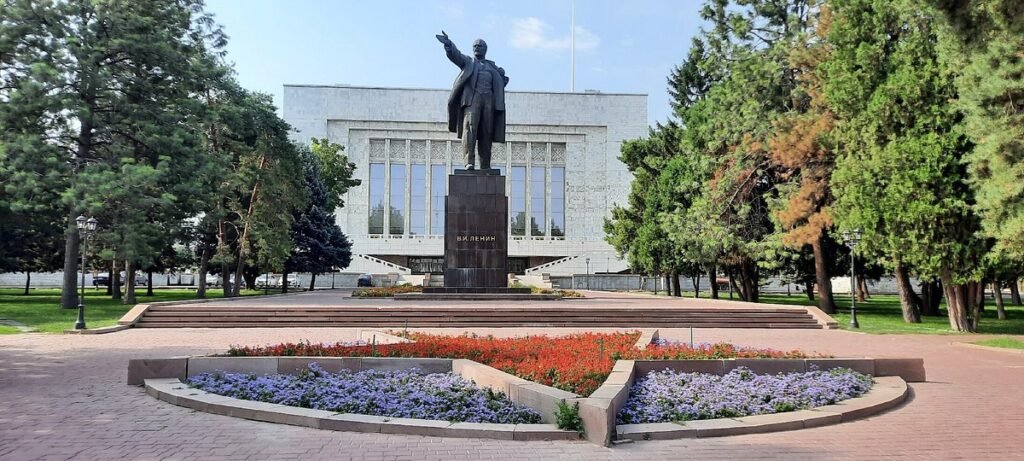
The Lenin Statue in بيشكيك is a large bronze monument to Vladimir Lenin, the leader of the Soviet Union. Today, the statue stands on the Old Square behind the National Historical Museum in the center of Bishkek.
The monument was originally installed in 1984 in the center of what is now Ala-Too Square, when the square was known as Lenin Square. After Kyrgyzstan became independent in 1991, the square was renamed Ala-Too Square, while the Lenin statue remained in its original position for more than a decade. In 2003, it was moved to the nearby Old Square, where it remains today.
The statue is an important surviving example of Bishkek’s Soviet-era monumental architecture and provides a direct connection between the city’s Soviet past and its post-independence urban landscape.
About the Lenin Statue
The monument was erected in 1984 as part of the development of Bishkek’s central square for the 60th anniversary of the Kyrgyz Soviet Socialist Republic.
The bronze statue depicts Lenin standing with his right arm extended. When the monument stood in the center of Lenin Square, the gesture pointed toward the Ala-Too mountains. After the statue was relocated, its orientation changed with the new position.
The monument was designed as a major piece of Soviet monumental art and originally stood on a prominent high pedestal in the center of the capital’s main public square.
Unlike many Lenin monuments that were removed or destroyed after the collapse of the Soviet Union, Bishkek’s statue was preserved and relocated to another central location.
Where Is the Lenin Statue in Bishkek?
The Lenin Statue is located on the Old Square, immediately behind the National Historical Museum in central Bishkek.
It is only a short walk from Ala-Too Square, making it easy to include in a walking tour of central Bishkek.
The location also makes the monument particularly interesting because visitors can see the relationship between the city’s Soviet-era and post-independence monuments within a small area.
History of the Lenin Statue
Lenin Square and the 1984 Monument
Bishkek’s central square was created in 1984 and was originally named Lenin Square. A large Lenin monument was placed at the center of the square.
The square and monument were part of the Soviet-era redevelopment of the capital and commemorated the 60th anniversary of the Kyrgyz Soviet Socialist Republic.
For many years, the statue was one of the dominant landmarks of central Bishkek.
After Kyrgyzstan’s Independence
Kyrgyzstan declared independence from the Soviet Union in 1991. The central square was renamed Ala-Too Square, but the Lenin monument remained in place.
This made Bishkek unusual among many former Soviet capitals, where prominent Lenin monuments were removed soon after independence.
The statue remained in the center of the square until 2003.
Relocation in 2003
In August 2003, the Lenin monument was removed from the center of Ala-Too Square and relocated to the Old Square behind the National Historical Museum.
The move was connected with the redevelopment of the central square. A monument representing Erkindik, or Freedom, was installed in Lenin’s former position.
The relocation generated public and political discussion at the time. Some representatives of Kyrgyzstan’s Communist Party opposed the decision, while the government proceeded with the redevelopment.
The statue itself was preserved rather than destroyed.
Lenin Statue and Ala-Too Square
The history of the Lenin Statue is closely connected with Ala-Too Square.
From 1984 until 1991, the square was officially known as Lenin Square. Lenin’s monument stood directly in its center.
After the statue was moved in 2003, the Erkindik monument occupied the central position. In 2011, the Manas monument replaced Erkindik as the principal monument in the square.
Today, visitors can therefore see the different stages of Bishkek’s public symbolism within a relatively small area:
- Lenin Statue — Soviet-era monument
- Erkindik monument — post-independence symbol of freedom
- Manas monument — symbol connected with Kyrgyz national heritage
The Lenin monument itself remains nearby on the Old Square rather than being removed from Bishkek altogether.
The Old Square
The Old Square is located behind the National Historical Museum and forms part of Bishkek’s historic administrative center.
Moving the Lenin monument here in 2003 changed its relationship with the city. Instead of occupying the symbolic center of Bishkek’s principal square, it became part of a smaller historic urban space.
The statue now faces toward the area of the Kyrgyz Parliament, according to historical accounts of its relocation.
For visitors interested in Bishkek’s history and architecture, the Old Square is therefore a useful stop between the National Historical Museum and other central landmarks.
What to See at the Lenin Statue
The Bronze Statue
The main attraction is the large bronze figure of Lenin. Its scale and formal Soviet monumental style make it noticeably different from the smaller monuments and sculptures found elsewhere in central Bishkek.
The Monument’s Original Location
Although Lenin no longer stands on Ala-Too Square, visitors can compare the statue’s current location with its original position.
The original pedestal site on Ala-Too Square later became the location of other important monuments.
Soviet-Era Monumental Art
The statue provides an example of the monumental style used throughout the Soviet Union, where large public monuments were used to represent political and historical figures in prominent urban spaces.
How to Visit the Lenin Statue
The Lenin Statue can be visited as part of a walking tour of central Bishkek.
A convenient route is:
Ala-Too Square → National Historical Museum → Lenin Statue → Old Square → Oak Park → Open-Air Sculpture Museum
Because the statue is outdoors, there is no separate museum admission or scheduled visit required to see the monument.
Best Time to Visit
The Lenin Statue can be visited throughout the year.
Spring, summer and early autumn are generally the most comfortable seasons for walking around central Bishkek. The monument can easily be combined with other nearby sights during a city walking tour.
Early morning or late afternoon can be more comfortable for walking during the warmer months.
Practical Information
- Type: Monument / Soviet-era landmark
- Location: Old Square, behind the National Historical Museum, Bishkek
- Visit duration: Around 10–20 minutes
- Admission: No separate entrance fee for the outdoor monument
- Access: Outdoor public location
The monument is best experienced together with the nearby National Historical Museum and Ala-Too Square.
Lenin Statue and Bishkek’s History
The Lenin Statue represents one layer of Bishkek’s urban history.
The city has changed significantly since the Soviet period, and its central public spaces contain monuments associated with different periods of Kyrgyz history.
The statue’s survival is particularly notable because it was not destroyed after independence. Instead, it was moved from the most prominent position in the city to a nearby location.
This makes the monument useful for understanding how Bishkek’s public spaces changed after 1991.
Tours to the Lenin Statue
The Lenin Statue can be included in a Bishkek city sightseeing itinerary together with:
- Ala-Too Square
- National Historical Museum
- Oak Park
- Open-Air Sculpture Museum
- Erkindik Boulevard
- Panfilov Park
- White House
For travelers visiting Bishkek for the first time, the statue is most useful as part of a wider historical and architectural walking route rather than as a standalone destination.
Places Near the Lenin Statue
Ala-Too Square
Bishkek’s main central square and the former location of the Lenin monument.
National Historical Museum
Located immediately beside the Old Square and Ala-Too Square, the museum provides broader historical context for Kyrgyzstan.
Oak Park
A historic central park with mature trees, monuments and the Open-Air Sculpture Museum.
Open-Air Sculpture Museum
An outdoor collection of sculptures located within Oak Park.
Panfilov Park
A historic city park with a distinctive star-shaped layout and amusement attractions.


