
Table des matières
ToggleChor Minor Bukhara
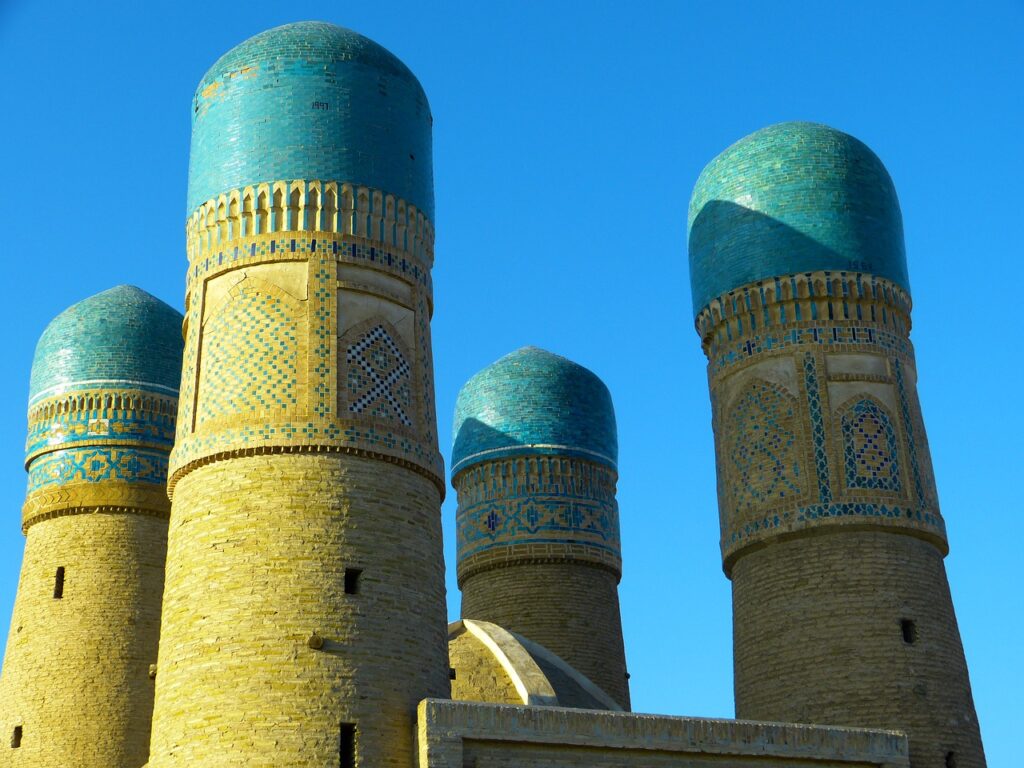
Chor Minor is one of the most distinctive architectural landmarks in Boukhara, Uzbekistan. Tucked away among the narrow streets of the historic Old Town, this small but remarkable monument stands out for its four corner towers crowned with blue-green domes. Its unusual design makes it instantly recognizable and gives it a character quite different from Bukhara’s monumental mosques and madrasas.
Le nom Chor Minor comes from Persian and means “Four Minarets.” Despite this name, the four towers are decorative architectural features rather than conventional minarets used for the call to prayer. The building is associated with the Khalifa Niyazkul Madrasa complex, traditionally dated to 1807 and established during the rule of Emir Haydar.
Chor Minor was once part of a larger religious and educational complex that included a madrasa, student rooms, a courtyard, and a mosque. Although much of the original complex no longer survives, the distinctive entrance building remains an important example of Bukhara’s architectural heritage.
Today, Chor Minor is a favorite stop for visitors exploring the city’s historic neighborhoods. Its compact size, unusual silhouette, and peaceful surroundings make it a rewarding destination for architecture enthusiasts, photographers, and travelers interested in Uzbekistan’s cultural history.
Where Is Chor Minor Located?
Chor Minor is located in the historic center of Bukhara, Uzbekistan, in a residential neighborhood a short walk from the popular Lyabi-Hauz Ensemble.
Unlike the grand monuments that dominate Bukhara’s main squares, Chor Minor is tucked away among smaller streets and traditional residential buildings. Finding it provides an opportunity to experience a quieter side of the Old Town.
Its location makes it easy to combine with other nearby attractions, including Lyabi-Hauz, Kukeldash Madrasa, Nadir Divan-Begi Madrasa, and Bukhara’s historic trading domes.
Emplacement : Historic Old Town, Bukhara, Uzbekistan.
The monument forms part of the historic urban environment of Bukhara, which UNESCO inscribed on the World Heritage List in 1993. The city’s historic center is recognized for its surviving Islamic architecture, traditional street layout, and importance as a cultural and commercial center along the Silk Roads.
History of Chor Minor
Construction During the Reign of Emir Haydar
Chor Minor is traditionally dated to 1807, during the reign of Emir Haydar of the Manghit dynasty. Its construction is associated with Khalifa Niyazkul, a wealthy Turkmen patron who is credited with financing the madrasa complex.
The building’s original function was connected with the entrance to a religious and educational institution. Its distinctive form reflects the architectural creativity of Bukhara during the late 18th and early 19th centuries.
Some heritage accounts note that records relating to the wider Khalifa Niyazkul Madrasa may indicate an earlier history. For this reason, 1807 is best presented as the traditional construction date rather than an entirely undisputed date for every part of the complex.
The Original Madrasa Complex
Chor Minor was not originally an isolated monument. It formed part of a larger complex that included a madrasa, a courtyard surrounded by student cells, and a small mosque.
Madrasas were important institutions in the Islamic world, providing religious education and accommodation for students. The layout of the complex reflected these functions, with the entrance building connecting the outside streets to the inner courtyard.
The four-towered structure became the most recognizable element of the complex, even though it was only one part of the original architectural ensemble.
The Meaning of the Four Towers
The four corner towers are the defining feature of Chor Minor. Their blue-green domes, varied shapes, and decorative surfaces distinguish the building from conventional madrasa entrances.
A popular interpretation suggests that the towers’ different decorative motifs represent four major world religions. Some observers identify shapes resembling Christian symbols or Buddhist prayer wheels in the ornamentation.
However, this interpretation is not conclusively established as the original intention of the builder. It is best treated as a theory about the symbolism rather than a confirmed historical explanation.
The towers’ architectural individuality is clear, even if their precise symbolic meaning remains uncertain.
Decline and Loss of the Original Buildings
Over time, much of the original madrasa complex disappeared. Historic records describe the loss of student cells and the deterioration and eventual demolition of the small mosque during the 20th century.
The remaining structure consequently represents only part of the original ensemble. Its survival is especially significant because it preserves an unusual example of Bukhara’s architectural history that might otherwise have been lost.
Restoration and Chor Minor Today
Chor Minor has undergone conservation and restoration work to preserve its distinctive form. Today, visitors can admire the entrance building, its four towers, the domes, and the surrounding courtyard area.
The monument has become one of Bukhara’s most recognizable photographic landmarks. Its relatively small scale makes it an appealing contrast to larger attractions such as the Ark Fortress and the Po-i-Kalyan Complex.
Architecture of Chor Minor
Chor Minor is famous for its compact proportions, four blue-domed towers, and distinctive combination of traditional Central Asian construction and decorative detail.
The Four Blue-Domed Towers
The building’s most striking feature is the arrangement of four towers at its corners. Each tower has its own proportions and decorative treatment, giving the structure a varied and unusual silhouette.
The towers are topped with small domes, often appearing blue or turquoise in photographs. Their placement creates a balanced composition around the central entrance building.
Although the towers resemble minarets, they do not function as four conventional prayer-call towers. Their principal importance lies in the building’s architectural design and distinctive appearance.
The Central Entrance Building
The main structure is a compact, two-storey gatehouse that once served as an entrance to the madrasa courtyard.
Its solid walls and simple geometric form contrast with the more elaborate towers at the corners. The entrance passage connects the exterior street with the former courtyard, reflecting the practical role the building played within the larger complex.
This combination of functional design and unusual decoration is one reason Chor Minor remains architecturally distinctive.
Brickwork and Traditional Materials
The building incorporates traditional materials associated with Bukhara’s historic architecture, including brick, timber, and masonry elements.
Brickwork forms the basic structure, while decorative surfaces and glazed details add color and visual interest. The result is a monument that feels connected to the city’s broader architectural traditions while maintaining its own identity.
The Domes and Decorative Details
The small domes above the towers create Chor Minor’s recognizable skyline. Their color contrasts with the more subdued tones of the building’s walls and surrounding residential neighborhood.
Look closely at the individual towers: their shapes and decorative elements are not identical. These differences give the building a playful and unusual quality that sets it apart from the more symmetrical façades found elsewhere in Bukhara.
The Courtyard and Remaining Complex
The entrance building originally led into a courtyard surrounded by madrasa rooms and other facilities. Although much of the original complex has been lost or altered, the surviving courtyard area helps visitors understand the building’s historical function.
The monument is best appreciated as the remaining part of a larger educational and religious institution rather than as a standalone four-towered mosque.
Why Is Chor Minor Famous?
Chor Minor is one of Bukhara’s most recognizable landmarks because of its unusual design and historical setting.
Four distinctive towers: The four corner towers with small domes give the building its name and unique silhouette.
Traditional construction date: It is commonly dated to 1807, during the reign of Emir Haydar.
Connection with a historic madrasa: The building was part of the Khalifa Niyazkul educational complex.
Unusual architectural design: Its compact gatehouse and four corner towers differ from the monumental portals of many other madrasas.
Distinctive decoration: The towers have different shapes and decorative motifs.
Photographic appeal: The blue-green domes and unusual proportions make Chor Minor a favorite subject for architectural photography.
Historic neighborhood setting: Its location near Lyabi-Hauz provides a glimpse of the quieter residential streets of old Bukhara.
Best Time to Visit Chor Minor
Chor Minor can be visited throughout the year, but the season and time of day can influence your experience.
Spring: March to May
Spring is one of the most comfortable seasons for exploring Bukhara on foot. Temperatures are often pleasant, making it easier to combine Chor Minor with nearby monuments and walking routes through the Old Town.
The surrounding neighborhood is particularly enjoyable when the weather is mild and suitable for outdoor photography.
Summer: June to August
Summer temperatures in Bukhara can become very high. Plan your visit for early morning or later in the afternoon, and carry water when walking between attractions.
Because Chor Minor is relatively compact, the visit itself may be short, but the walk through the surrounding streets can still be hot.
Autumn: September to November
Autumn is another excellent season for visiting Chor Minor. The weather often becomes more comfortable, and the softer light can help bring out the colors and details of the towers.
It is also a good time to explore nearby Lyabi-Hauz and the traditional streets of the Old Town.
Winter: December to February
Winter visits are possible, although temperatures can be cold. The monument’s distinctive silhouette remains attractive in different weather conditions, and the surrounding neighborhood may feel quieter.
Check local access arrangements if you plan to enter any interior spaces.
Best time of day: Early morning is a good choice for quieter photographs, while late afternoon can provide attractive light on the domes and brickwork.
Places to Visit Near Chor Minor
Chor Minor is ideally located for exploring other historic attractions in Bukhara. Several can be combined into a walking tour.
1. Lyabi-Hauz Ensemble
Les Lyabi-Hauz Ensemble is one of Bukhara’s most atmospheric historic areas. Built around a traditional pond, it includes Kukeldash Madrasa, Nadir Divan-Begi Khanaka, and Nadir Divan-Begi Madrasa.
The combination of historic architecture, water, mature trees, and nearby cafés makes it a pleasant place to relax after visiting Chor Minor.
2. Kukeldash Madrasa
Kukeldash Madrasa is one of the largest historic educational buildings in Bukhara. Dating to 1568–1569, it stands beside the Lyabi-Hauz pond and illustrates the importance of religious education in the city’s history.
Its scale and traditional madrasa layout provide an interesting contrast with the compact design of Chor Minor.
3. Nadir Divan-Begi Madrasa
This 17th-century madrasa is famous for its elaborate entrance portal and unusual figurative tile decoration. Its blue and turquoise patterns make it one of the most visually striking buildings in the Lyabi-Hauz Ensemble.
4. Bukhara’s Trading Domes
The historic trading domes once sheltered merchants and specialized markets along Bukhara’s commercial routes.
Today, the covered bazaars contain shops selling traditional crafts, textiles, ceramics, jewelry, and souvenirs. They offer a glimpse into the city’s long history as a trading center.
5. Po-i-Kalyan Complex
Po-i-Kalyan is one of Bukhara’s most famous architectural ensembles, featuring the Kalon Minaret, Kalon Mosque, and Mir-i-Arab Madrasa.
The complex is particularly impressive for its monumental scale and decorative brickwork. It provides a striking comparison with Chor Minor’s more intimate design.
6. Ark Fortress
Les Forteresse de l'Ark served as the citadel and residence of Bukhara’s rulers for centuries. Its walls, gates, and museum spaces offer insight into the political and administrative history of the city.
7. Bolo Hauz Mosque
Located opposite the Ark Fortress, Bolo Hauz Mosque is known for its carved wooden columns, painted ceiling, and historic pond. It is a rewarding stop for travelers interested in traditional Uzbek decorative arts.
Travel Tips for Visiting Chor Minor
Keep these practical tips in mind when planning your visit:
Allow time to find the monument: Chor Minor stands among residential streets rather than on a large main square.
Explore the building from different angles: Walk around the structure to appreciate the different shapes and decoration of the four towers.
Look closely at the domes: The blue-green finishes are among the monument’s most recognizable features.
Combine it with Lyabi-Hauz: The two attractions are close enough to visit on the same walking route.
Dress respectfully: Bukhara’s historic center contains active religious sites, so modest clothing is advisable.
Respect residential privacy: The monument is located in a lived-in neighborhood. Avoid disturbing residents or photographing private homes without permission.
Check interior access: Entry to upper rooms or other interior spaces may depend on current arrangements.
Carry water during summer: The walk between historic attractions can be uncomfortable during the hottest part of the day.
Ask before photographing people: Be considerate of residents, local workers, and other visitors.
Confirm current fees locally: Ticket prices and access rules can change, so verify details before your visit.
Chor Minor – Quick Information Table
| Fonctionnalité | Détails |
|---|---|
| Nom | Chor Minor |
| Alternative name | Khalifa Niyazkul Madrasa |
| Name meaning | “Four Minarets” |
| Lieu | Historic Old Town, Bukhara, Uzbekistan |
| Traditional construction date | 1807 |
| Historical period | Early 19th century |
| Patron | Khalifa Niyazkul |
| Original function | Entrance building associated with a madrasa complex |
| Main architectural feature | Four corner towers topped with small domes |
| Main materials | Traditional brickwork and masonry, with decorative elements |
| Original complex | Madrasa, student rooms, courtyard, and mosque |
| Present condition | Surviving entrance building and associated restored elements |
| Attraction à proximité | Lyabi-Hauz Ensemble |
| Heritage context | Located within Bukhara’s historic center, a UNESCO World Heritage Site |
| Recommended visit duration | Around 15–30 minutes |
| Visitor access | Check current local arrangements for entry to interior spaces |
The 1807 date is the traditional dating of Chor Minor, though heritage records note uncertainty about the earlier history of the associated madrasa. Visit duration is an estimate.


