
Table des matières
ToggleKalta Minor Minaret in Khiva: History & Architecture
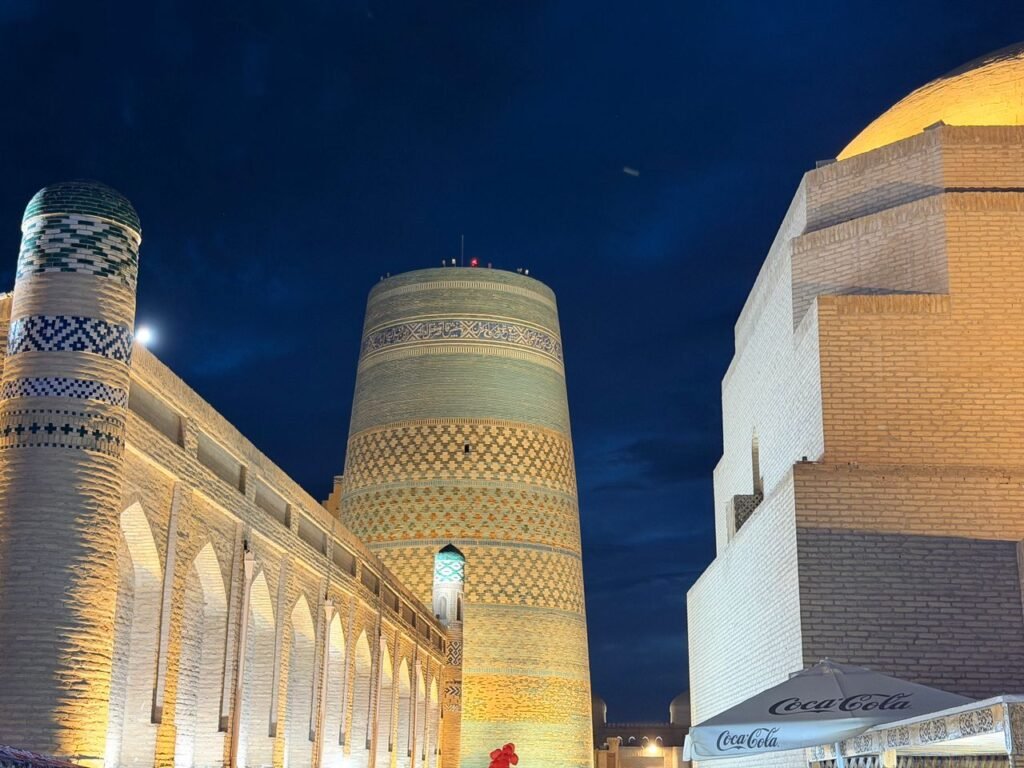
The Kalta Minor Minaret in Khiva, Uzbekistan, is one of the most recognizable architectural landmarks in Central Asia. Famous for its brilliant turquoise, blue, and white glazed tiles, this unusual monument stands in the historic walled city of Ichan Kala. Unlike traditional minarets that rise high above surrounding buildings, Kalta Minor is broad, relatively short, and unfinished, making it instantly recognizable to visitors.
Built during the 19th century under the direction of Muhammad Amin Khan, Kalta Minor was intended to become a monumental tower that would demonstrate the power and prestige of the Khanate of Khiva. Although construction stopped before the original vision could be completed, the structure developed into one of the city’s most celebrated sightseeing attractions.
For travelers exploring Khiva’s ancient streets, historic madrasas, and traditional Islamic architecture, Kalta Minor Minaret offers an excellent introduction to the city’s rich cultural heritage.
Where Is Kalta Minor Minaret Located?
Kalta Minor Minaret is located inside Ichan Kala, the historic inner city of Khiva in Uzbekistan’s Khorezm region. It stands beside the Muhammad Amin Khan Madrasa, close to the western entrance of the old city.
The surrounding area features traditional brick buildings, historic courtyards, narrow streets, and other remarkable monuments. Because of its prominent position and colorful exterior, the minaret is easy to recognize while exploring the old town on foot.
Ichan Kala is a UNESCO World Heritage Site, celebrated for its remarkably preserved historic architecture and cultural significance. Visiting Kalta Minor therefore allows travelers to experience not only an individual monument but also the wider historic atmosphere of Khiva.
History of Kalta Minor Minaret
The story of Kalta Minor began during the reign of Muhammad Amin Khan in the mid-19th century. Construction started around 1852, although some historical accounts give slightly different dates. The ruler envisioned an exceptionally tall minaret that would distinguish Khiva from other important cities of the region.
The planned structure was ambitious. Its unusually wide foundation was designed to support a much taller tower, with the diameter narrowing toward the top. Historical descriptions commonly suggest that the completed minaret might have reached approximately 70 to 80 meters, although estimates vary.
However, the project came to an abrupt halt in 1855 following the death of Muhammad Amin Khan. The minaret remained unfinished, preserving the broad, truncated shape that visitors see today.
Over time, the incomplete structure became a defining symbol of Khiva rather than simply a reminder of an abandoned construction project.
The Legend Behind the Unfinished Minaret
Several local stories attempt to explain why Kalta Minor was never completed. One popular legend describes a rivalry between the ruler of Khiva and the Emir of Bukhara.
According to the story, the Emir of Bukhara wanted to construct a similarly impressive minaret and became interested in the plans for Khiva’s tower. The architect allegedly became involved in secret negotiations, leading to a dispute that prevented the project from reaching completion.
This account is a local legend rather than a firmly established historical explanation. The death of Muhammad Amin Khan in 1855 is the commonly cited historical reason construction stopped.
Today, the legend adds another layer of intrigue to the monument, encouraging visitors to discover the stories and traditions surrounding Khiva’s architectural heritage.
Architecture and Unique Blue Tilework
The most striking feature of Kalta Minor Minaret is its exterior decoration. The tower is covered with glazed ceramic tiles and majolica in shades of turquoise, deep blue, and white. Decorative bands and geometric patterns create a rich visual effect that changes with the natural light.
Unlike many traditional minarets, which are relatively slender and taper upward, Kalta Minor has a massive cylindrical base and a truncated upper section. This distinctive shape gives it a powerful appearance despite its incomplete height.
Its base measures approximately 14.5 meters in diameter, while published sources give its present height as roughly 26–29 meters. Differences in reported height reflect variations between historical and modern descriptions.
The elaborate tilework is particularly important to the monument’s identity. Uzbekistan’s official tourism information describes Kalta Minor as unique for having its exterior completely covered with glazed tiles and majolica.
The result is a remarkable combination of engineering ambition and decorative craftsmanship. Even without its intended height, the minaret remains one of the most visually impressive sights in Khiva.
Why Is Kalta Minor Minaret Famous?
Kalta Minor is famous for several reasons that make it a highlight of sightseeing in Khiva.
1. Its unfinished design: The tower was intended to become a much taller structure, but construction stopped before the original plan was realized.
2. Its brilliant blue colors: Turquoise, cobalt-blue, and white tiles make the minaret stand out against the sandy tones of the surrounding historic buildings.
3. Its historical importance: The monument reflects the ambitions of Muhammad Amin Khan and the architectural development of 19th-century Khiva.
4. Its distinctive proportions: The unusually wide base and relatively short height give the structure an appearance unlike that of most other minarets.
5. Its location in Ichan Kala: The minaret is part of one of Uzbekistan’s most important historic urban landscapes, making it a natural stop on a walking tour of Khiva.
Together, these characteristics have transformed Kalta Minor into one of the most photographed landmarks in the country.
Best Time to Visit Kalta Minor Minaret
Kalta Minor can be visited throughout the year, but the experience varies depending on the season and time of day.
Spring and autumn are generally comfortable seasons for exploring Khiva on foot. The weather is often more suitable for walking between monuments, visiting historic courtyards, and photographing the old city.
Early morning is an excellent time to see the minaret with fewer visitors around. The softer light can also bring out the colors and textures of the glazed tiles. Late afternoon provides another attractive opportunity for photography as the light becomes warmer.
Summer can be very hot in Khiva, so visitors should carry water, wear sun protection, and plan outdoor sightseeing during cooler hours where possible. Winter offers a quieter atmosphere, although temperatures can be cold.
For the best experience, allow time to admire the minaret from different viewpoints rather than stopping only for a quick photograph.
Things to See Near Kalta Minor Minaret
Kalta Minor is surrounded by several important historical attractions, making it easy to include in a broader Khiva sightseeing itinerary.
Muhammad Amin Khan Madrasa
Located beside the minaret, Muhammad Amin Khan Madrasa is an impressive historic educational complex commissioned by the same ruler. Its monumental entrance, traditional brickwork, and courtyard architecture complement the distinctive appearance of Kalta Minor.
Kunya-Ark Citadel
Kunya-Ark was an important fortified residence of Khiva’s rulers. The complex contains historic courtyards and buildings that provide insight into the political and ceremonial life of the khanate.
Mosquée Juma
Juma Mosque is well known for its remarkable interior supported by rows of wooden columns. The combination of carved timber and traditional Islamic design makes it one of the most distinctive religious buildings in Khiva.
Islam Khoja Minaret
Another notable landmark in the old city, Islam Khoja Minaret contrasts sharply with Kalta Minor. Its slender profile and considerable height demonstrate a different approach to minaret architecture.
Pahlavon Mahmud Mausoleum
This important religious and historical complex is associated with Pahlavon Mahmud, a celebrated poet, craftsman, and wrestler who became a revered figure in Khiva’s cultural traditions.
Exploring these attractions together provides a deeper understanding of Khiva’s architectural styles, religious heritage, and historical development.
Travel Tips for Visiting Kalta Minor
To make your sightseeing experience more enjoyable, consider the following practical recommendations:
Wear comfortable shoes: The historic center is best explored on foot, and some streets have uneven or traditional paving.
Bring a camera: The colorful tilework creates excellent photographic opportunities from different angles.
Visit early or late: Morning and late-afternoon light can be more flattering for architectural photography.
Explore the surrounding madrasa: The neighboring historic complex adds context to the minaret’s original purpose.
Allow time for Ichan Kala: Do not limit your visit to the tower alone; explore the surrounding streets, museums, mosques, and courtyards.
Check ticket arrangements: Entry requirements and charges for monuments or museum interiors may change. Confirm current details locally before visiting.
Respect local customs: Dress appropriately when entering religious or culturally significant spaces, and follow any posted visitor instructions.
Kalta Minor Minaret Information Table
| Fonctionnalité | Détails |
|---|---|
| Nom | Minaret mineur de Kalta |
| Lieu | Ichan Kala, Khiva, Uzbekistan |
| Région | Khorezm Region |
| Construction period | Began around 1852 |
| Patron | Muhammad Amin Khan |
| Construction halted | 1855 |
| Present height | Approximately 26–29 meters |
| Planned height | Commonly estimated at 70–80 meters |
| Base diameter | Approximately 14.5 meters |
| Style architectural | Traditional Khorezm and Islamic architecture |
| Main materials | Brick and glazed ceramic tiles |
| Main colors | Turquoise, blue, and white |
| Famous feature | Unfinished form and richly decorated exterior |
| Attraction à proximité | Muhammad Amin Khan Madrasa |
| Historic setting | Ichan Kala UNESCO World Heritage Site |
| Recommended visit duration | Around 20–40 minutes for the minaret and immediate surroundings |
Historical dimensions are approximate and may vary between published sources. The suggested visit duration is a planning estimate, not an official time limit.


