
Table des matières
ToggleRegistan Square, Samarkand
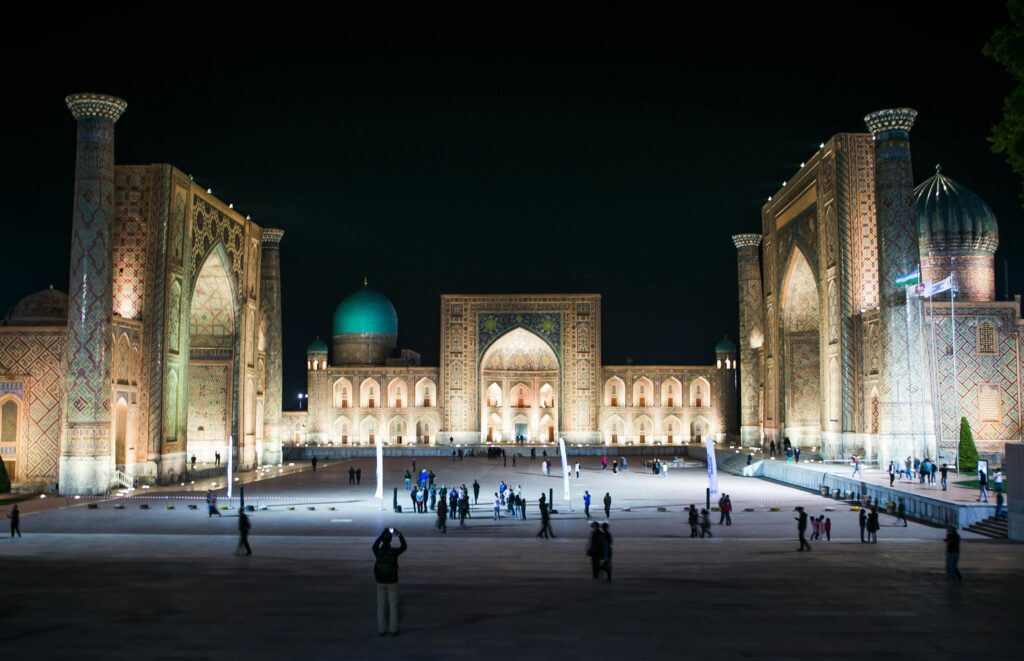
Registan Square is one of the most famous historical landmarks in Uzbekistan and a must-visit destination for anyone exploring the ancient city of Samarcande. Surrounded by three magnificent madrasahs decorated with intricate mosaics, colorful tiles, and monumental gateways, the square represents the architectural brilliance of the Timurid era and the rich cultural heritage of Central Asia.
For centuries, Registan served as a center of public life, education, trade, and official ceremonies. Today, it is one of the most recognizable sights along the Silk Road and a highlight of any trip to Samarkand. Its impressive architecture, detailed ornamentation, and atmospheric setting make it an unforgettable destination for history enthusiasts, photographers, and travelers interested in Islamic art.
Whether you are visiting Uzbekistan for the first time or planning a deeper exploration of its historic cities, Registan Square offers an excellent introduction to the country’s extraordinary past.
History of Registan Square
The name Registan is commonly translated as “sandy place” or “place of sand.” In earlier centuries, the square served as a central gathering area where residents could attend public announcements, markets, ceremonies, and other important events.
Samarkand was an important center of trade and culture along the Silk Road. Its location connected merchants, scholars, artisans, and travelers moving between different parts of Asia and the Middle East. As the city developed, Registan became one of its principal public spaces.
The square gained much of its architectural importance during the period of Amir Timur and his successors. Timur made Samarkand the capital of his empire in the late 14th century, encouraging the construction of monumental buildings and attracting skilled craftsmen from across his territories.
The Registan architectural ensemble developed over several centuries. Its three madrasahs were constructed at different times, gradually transforming the square into a remarkable center of religious education and public life.
During the 20th century, extensive restoration work helped preserve the buildings and their elaborate decorative features. Today, Registan Square is recognized as part of Samarkand’s UNESCO World Heritage-listed historic center, reflecting the city’s significance in the history of Central Asian civilization.
The Three Madrasahs of Registan Square
The defining feature of Registan Square is its three monumental madrasahs. Each building has a distinctive architectural character, yet together they create one of the most harmonious historic ensembles in the Islamic world.
1. Ulugh Beg Madrasah
The Ulugh Beg Madrasah stands on the western side of the square and is the oldest of the three main buildings. It was constructed in the 15th century under Ulugh Beg, a Timurid ruler renowned for his interest in astronomy, mathematics, and scholarship.
Ulugh Beg believed that education and scientific knowledge were essential to the development of society. His madrasah became an important place for students studying religious subjects alongside mathematics, astronomy, and other fields of learning.
The building features a monumental entrance portal, geometric tilework, decorative inscriptions, and elegant architectural proportions. Its courtyard and surrounding student rooms reveal how traditional madrasahs were designed to support teaching and residential life.
The Ulugh Beg Madrasah is especially significant because it represents the intellectual ambitions of the Timurid period. It reminds visitors that Samarkand was not only a political capital but also a center of scientific and cultural achievement.
2. Sher-Dor Madrasah
The Sher-Dor Madrasah stands opposite the Ulugh Beg Madrasah, on the eastern side of the square. It was built in the 17th century under the Shaybanid ruler Yalangtush Bahadur.
The name Sher-Dor is commonly translated as “having lions” or “adorned with tigers.” The building is famous for the unusual images on its entrance portal, which depict powerful feline-like creatures pursuing deer beneath sun-like faces.
These figures are particularly interesting because Islamic architectural decoration often emphasizes geometric patterns, calligraphy, and plant motifs. The imagery at Sher-Dor makes the building distinctive within the Registan ensemble.
Its richly decorated façade features blue, turquoise, and golden tones, creating a striking contrast with the surrounding architecture. The intricate tilework demonstrates the craftsmanship and artistic imagination of the period.
Visitors should take time to examine the portal closely. The decorative details reveal patterns and symbolic imagery that can easily be missed when viewing the building from across the square.
3. Tilya-Kori Madrasah
The Tilya-Kori Madrasah occupies the northern side of Registan Square and completes the architectural ensemble. It was built in the 17th century and served both educational and religious purposes.
The name Tilya-Kori is often translated as “decorated with gold,” referring to the rich gilded ornamentation found inside its mosque. The interior is one of the most impressive spaces at Registan, with intricate patterns, painted surfaces, and golden decoration that create a luminous atmosphere.
Unlike the other two madrasahs, Tilya-Kori includes a prominent mosque that played an important role in the religious life of the city. Its design combines the functions of a school and a place of worship within a single monumental complex.
The contrast between the exterior’s blue tilework and the richly decorated interior makes this building particularly rewarding to explore. For many visitors, the gilded mosque is one of the most memorable features of Registan Square.
Architectural Highlights of Registan Square
Registan Square is an outstanding example of Central Asian Islamic architecture. Its buildings combine monumental scale with detailed decoration, creating an environment that feels both grand and carefully balanced.
Intricate Mosaic and Tilework
Blue and turquoise tiles are among the most recognizable features of Registan Square. They cover large sections of the façades, forming geometric patterns, floral designs, and decorative inscriptions.
The tiles reflect changing light throughout the day. In the morning, the colors can appear soft and cool, while late-afternoon sunlight often brings out richer shades of blue and gold.
Monumental Entrance Portals
Each madrasah features a large entrance portal known as a pishtaq. These towering structures frame the entrances and emphasize the importance of the buildings.
Their surfaces are covered with intricate ornamentation, including symmetrical patterns, calligraphy, and decorative borders. The scale of the portals creates an immediate sense of grandeur.
Geometric Patterns and Calligraphy
Islamic architectural decoration often uses repeating geometric forms and carefully arranged inscriptions. At Registan, these elements create visual rhythm across the walls, arches, and domes.
The designs reflect a sophisticated understanding of geometry and artistic composition. Looking closely at the patterns reveals the skill required to create such elaborate surfaces.
Domes and Courtyards
The madrasahs feature domes, arched galleries, and spacious courtyards that organize the buildings around central open spaces. These courtyards were important for education, daily activities, and movement between different rooms.
Their layouts also provide excellent opportunities to appreciate the architecture from multiple angles.
Things to See and Do at Registan Square
Registan Square is more than a place to admire historic façades. Exploring the buildings and taking time to appreciate their details can make a visit much more rewarding.
Walk Around the Entire Square
Begin by viewing the three madrasahs from the center of the square. This gives you a clear sense of how the buildings relate to one another and how their different designs create a balanced architectural composition.
Walk around the perimeter as well. Each change in position reveals new details in the tilework, portals, and domes.
Explore the Madrasah Courtyards
Where visitor access is permitted, enter the madrasahs to discover their internal courtyards, galleries, and former student rooms. These spaces help explain how the buildings functioned as educational institutions.
Look for differences between the three complexes, especially the distinctive gilded mosque inside Tilya-Kori and the unusual portal decoration at Sher-Dor.
Photograph the Architecture
Registan Square is one of the best photography locations in Samarkand. Wide-angle photographs capture the scale of the ensemble, while close-up images highlight the tilework and decorative inscriptions.
Early morning is often a good time for quieter views, while late afternoon can provide warm light. Evening illumination may also create dramatic photographic opportunities when available.
Always check the current rules for photography inside individual buildings, especially if special exhibitions or events are taking place.
Visit After Sunset
Registan Square can look especially atmospheric after dark when the historic façades are illuminated. The lighting emphasizes the height of the portals and the different shapes of the domes.
Depending on the season and event schedule, cultural performances or special evening programs may be held at the square. These arrangements can change, so confirm the current schedule before planning your visit around a particular show.
Learn About Samarkand’s History
A guided visit can help explain the relationship between Registan Square, the Timurid dynasty, and the wider Silk Road network. Guides can also provide context for the architectural symbolism and historical changes that are not immediately obvious from the buildings themselves.
Even travelers who prefer exploring independently may benefit from reading about Ulugh Beg and the development of the three madrasahs before arriving.
Best Time to Visit Registan Square
Registan Square can be visited throughout the year, but spring and autumn are often the most comfortable seasons for exploring Samarkand.
Spring (March to May): Temperatures generally become more pleasant, making it an excellent time to walk around the square and visit other outdoor attractions.
Summer (June to August): Days can be extremely hot. Visit early in the morning or later in the afternoon to avoid the strongest midday heat.
Autumn (September to November): Mild weather and comfortable sightseeing conditions make autumn a popular season for exploring the city’s historic landmarks.
Winter (December to February): The square can be quieter, and the architecture remains impressive in cooler weather. However, temperatures can be low, so warm clothing is advisable.
For photography, consider visiting early in the morning for fewer people or in the late afternoon for warm natural light. If you want to see the illuminated buildings, check whether evening access is available on your chosen date.
How to Get to Registan Square
Registan Square is located in the historic center of Samarkand and is easy to reach from many hotels and major tourist areas.
From Samarkand Railway Station
Samarkand’s railway station is connected to other major Uzbek cities, including Tashkent. From the station, visitors can reach Registan Square by taxi or local transport. Travel time depends on traffic and the exact starting point.
From Samarkand International Airport
Travelers arriving by air can take a taxi or arrange a transfer to the historic center. Allow extra time for traffic, particularly during busy travel periods.
Getting Around the Historic Center
Many of Samarkand’s principal attractions can be combined into a sightseeing route. Depending on the weather and your preferred pace, you can visit Registan Square alongside nearby historic monuments by walking and using taxis for longer distances.
If you plan to visit several sites in one day, check opening hours and entry arrangements in advance.
Practical Visitor Information
Before visiting Registan Square, keep these useful tips in mind:
Entry tickets: Access to the square and its individual buildings may be subject to ticketing arrangements. Check current prices and which areas are included before arrival.
Opening hours: Visiting hours can vary by season, holidays, restoration work, and special events.
Time needed: Allow around one to two hours for a general visit. Travelers interested in architecture and photography may prefer to spend longer.
Vêtements : Comfortable walking shoes are recommended because you will be walking across large open areas and through historic buildings.
Weather: Bring water and sun protection during warmer months. In winter, wear layers to stay comfortable outdoors.
Photography: Check local rules for indoor photography and any restrictions that may apply during performances or special events.
Respectful behavior: Remember that the complex includes religious and educational heritage buildings. Follow posted instructions and respect any designated prayer or restricted areas.
Places to Visit Near Registan Square
Registan Square is an excellent starting point for discovering Samarkand’s other historic landmarks. Several important attractions can be included in the same itinerary.
Mausolée Gur-e-Amir
Gur-e-Amir is the mausoleum associated with Amir Timur and members of his family. Its striking dome, decorative interior, and historical significance make it one of Samarkand’s most important monuments.
The building offers insight into the funerary architecture of the Timurid period and complements a visit to Registan Square.
Mosquée Bibi-Khanym
Bibi-Khanym Mosque is a monumental historic mosque connected with the legacy of Amir Timur. Its imposing entrance, large scale, and surviving architectural features illustrate the ambitions of Samarkand’s rulers.
The mosque is a valuable stop for travelers interested in the city’s religious and architectural history.
Shah-i-Zinda Necropolis
Shah-i-Zinda is a remarkable complex of mausoleums featuring richly decorated façades, colorful tiles, and elaborate architectural details. The site is particularly well known for its blue and turquoise ornamentation.
Visitors interested in the tilework at Registan will find plenty to admire here as well.
Observatoire d'Ulugh Beg
The Ulugh Beg Observatory is associated with the celebrated astronomer and ruler Ulugh Beg. Its remains and museum help explain Samarkand’s role in the history of astronomy and scientific observation.
It is a useful addition for travelers who want to understand the scholarly traditions represented by the Ulugh Beg Madrasah.
Bazar Siab
Siab Bazaar offers a different perspective on Samarkand’s culture. The market is known for local produce, dried fruit, nuts, sweets, spices, and traditional bread.
A visit provides an opportunity to experience everyday life and sample regional products after exploring the city’s monumental architecture.
Suggested One-Day Itinerary in Samarkand
If you have one full day to explore Samarkand, Registan Square can serve as the centerpiece of your sightseeing plan.
Morning: Begin at Registan Square while the weather is cooler. Explore the three madrasahs and spend time examining the architectural details.
Late morning: Visit Gur-e-Amir Mausoleum to learn more about Amir Timur and the Timurid dynasty.
Afternoon: Continue to Bibi-Khanym Mosque and Siab Bazaar. Enjoy local food or browse the market for traditional products.
Late afternoon: Visit Shah-i-Zinda Necropolis and admire its richly decorated mausoleums.
Evening: Return to Registan Square if evening access or illumination is available, allowing you to see the ensemble in a different atmosphere.
This itinerary can be adjusted according to opening hours, travel pace, weather, and the amount of time you wish to spend at each site.
Why Registan Square Is Worth Visiting
Registan Square brings together architecture, history, education, and art in one extraordinary setting. Its three madrasahs represent different periods of Samarkand’s development, while their decorative details reveal the craftsmanship of generations of Central Asian artisans.
The square also offers a broader understanding of the Silk Road. Samarkand was a place where merchants, scholars, travelers, and craftspeople met, exchanging ideas and contributing to the city’s cultural influence.
Whether you are interested in historic architecture, Islamic art, photography, or the history of Uzbekistan, Registan Square is one of the most rewarding places to visit in the country.


