
Table des matières
ToggleHoly Trinity Cathedral in Karakol, Kyrgyzstan
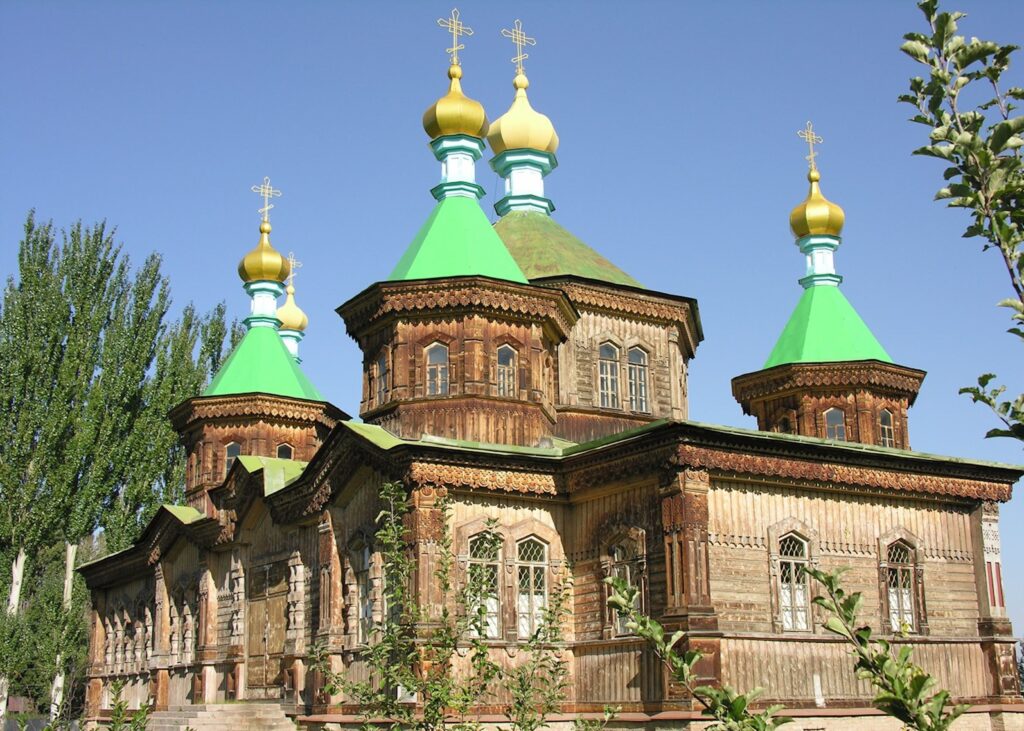
The Holy Trinity Cathedral is a historic Russian Orthodox wooden church in the center of Karakol, Kyrgyzstan. Built in 1894–1895 after an earlier church was destroyed by an earthquake, it is one of the city’s most distinctive architectural landmarks.
The church is particularly notable for its wooden construction, traditional Orthodox domes, carved details and long history. It is also an active place of worship, so visitors should treat it as a religious site rather than simply a monument.
About Holy Trinity Cathedral
The history of the church goes back to the foundation of Karakol in the 19th century. An early church was established for the military community in 1869. After the original building was destroyed by an earthquake, a new wooden church was constructed and consecrated in 1895.
The present building was supported by the local Maslikov merchant family and constructed according to a design associated with engineers from Verny, today’s Almaty. Its wooden structure reflects the adaptation of church architecture to the earthquake-prone conditions of the region.
At a Glance
Information | Details |
Type of Place | Architecture Complex |
Location | Karakol, Issyk-Kul Region |
Built | 1894–1895 |
Architecture | Wooden Orthodox church |
Religion | Russian Orthodox |
Status | Active church |
Main feature | Historic wooden architecture |
Nearby | Dungan Mosque, Karakol city center |
Where Is Holy Trinity Cathedral?
The cathedral is located in central Karakol, making it easy to include in a walking tour of the city’s historic architecture. Visit Karakol identifies the church as being in the city center, and current map listings place it at Gagarin Street 16.
Its central location also makes it convenient to combine with the Dungan Mosque and other historic buildings in Karakol.
Wooden Architecture
One of the main reasons to visit Holy Trinity Cathedral is its wooden construction.
After earthquakes damaged masonry churches in the region during the late 19th century, wooden churches became an important architectural solution in the area. The cathedral combines traditional Orthodox church forms with construction adapted to local conditions.
The building has a cross-shaped composition, five domes and a wooden bell tower. Its exterior includes carved wooden elements and decorative details characteristic of the historic church.
The Five Domes and Bell Tower
The upper part of the cathedral is dominated by five domes and a distinctive tent-shaped bell tower.
Historical descriptions note that the completed church was once the tallest building in Karakol, with the top of the cross reaching approximately 26 meters.
The combination of the wooden walls, domes and bell tower gives the cathedral a distinctive silhouette within the historic center of Karakol.
Interior and Icons
The interior contains Orthodox religious artwork and icons.
One of the historically important icons associated with the church is the Tikhvin Icon of the Mother of God. Sources describing the church also mention other religious objects and icons that survived or were brought back during the restoration of the church.
Because this is an active church, visitors should remember that the interior is a religious space and that photography or access may be restricted during services.
History of Holy Trinity Cathedral
The church has experienced several very different periods in its history.
The original church was established soon after Karakol was founded. A masonry church followed, but it was destroyed by an earthquake, leading to construction of the present wooden building, which was consecrated in 1895.
After the Russian Revolution and during the Soviet period, the building was closed as a religious institution and was used for various secular purposes, including educational, sporting and other functions. Parts of the original religious interior and furnishings were lost during this period.
Restoration began during the late Soviet period. After Kyrgyzstan’s independence, the building was returned to the Orthodox community and further restoration work was carried out.
Holy Trinity Cathedral and Karakol’s History
The cathedral is an important part of Karakol’s architectural heritage.
Together with the Dungan Mosque and other historic buildings, it reflects the multicultural history of the city and the different communities that shaped Karakol during the 19th and 20th centuries.
For visitors, the two religious buildings also provide an interesting architectural contrast: the Orthodox cathedral is a historic wooden church, while the Dungan Mosque is known for its Chinese-influenced wooden architecture.
How to Visit Holy Trinity Cathedral
The cathedral is in central Karakol and can be reached on foot from other central sights.
It can be visited independently or included in a walking tour of Karakol’s historic architecture.
A typical cultural route can combine:
- Holy Trinity Cathedral
- Dungan Mosque
- Historic streets of central Karakol
- Local markets and food stops
- Other architectural landmarks
If visiting as part of a tour, allow enough time to appreciate the exterior as well as the interior.
Visitor Etiquette
Holy Trinity Cathedral is an active Orthodox church.
Visitors should:
- dress respectfully
- keep voices low inside
- avoid disturbing religious services
- ask before taking close-up photographs of people or religious ceremonies
- follow any instructions from church staff or clergy
Women may be asked to cover their head, and modest clothing is appropriate when entering the church. Current visitor requirements can vary.
Best Time to Visit
Holy Trinity Cathedral can be visited throughout the year.
Summer is convenient for combining the church with a broader Karakol walking tour and nearby outdoor attractions. Winter can also be interesting because Karakol becomes a base for skiing and mountain activities.
For a quieter visit, consider going outside major religious services and busy tour periods.
Practical Information
The cathedral is an active place of worship, so opening times and visitor access should be checked before visiting.
There may be different conditions for tourists during religious services or special Orthodox holidays.
Recommended time: around 30–60 minutes.
Accessibility: the cathedral is in central Karakol and is relatively easy to reach as part of a city walking route.
Holy Trinity Cathedral and the Dungan Mosque
Holy Trinity Cathedral and the Dungan Mosque are two of the best-known historic religious buildings in Karakol.
They represent very different architectural traditions and reflect the multicultural history of the city.
Places Near Holy Trinity Cathedral
Nearby sights and attractions can include:
- Dungan Mosque
- Karakol city center
- Historic Karakol architecture
- Issyk-Kul Lake
- Jeti-Oguz
- Altyn-Arashan
- Karakol Valley
The cathedral is particularly easy to combine with the Dungan Mosque as part of a short architectural walking route.


