
Table des matières
ToggleDungan Mosque in Karakol, Kyrgyzstan
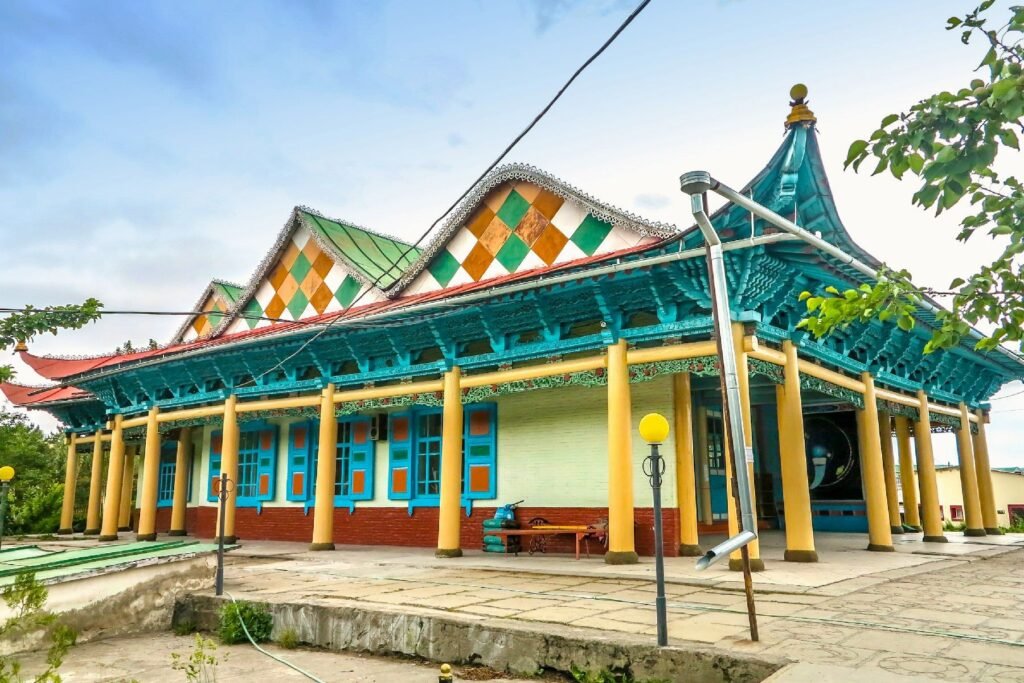
The Dungan Mosque is one of the most distinctive historical landmarks in Karakol, Kyrgyzstan. Built for the city’s Dungan Muslim community in the early 20th century, the wooden mosque combines Islamic religious function with traditional Chinese and Dungan architectural design.
The building is particularly famous for its colorful carved decoration, Chinese-style roof forms and timber construction using traditional joinery rather than conventional metal nails. It remains an active mosque today.
About the Dungan Mosque
The history of the mosque is closely connected with the arrival of Dungan communities in the Karakol area during the late 19th century.
Dungan Muslims who had fled China settled in and around Karakol and established their own community. As the community developed, a mosque became an important religious and social center.
The present wooden mosque was constructed in the early 20th century under the direction of the Chinese architect and master craftsman Zhou Si, together with craftsmen from China and local workers.
Construction was completed in 1910, according to the most commonly cited historical sources.
Dungan Mosque at a Glance
Information | Details |
Type of Place | Architecture Complex |
Location | Karakol, Issyk-Kul Region |
Main character | Historic Dungan mosque |
Architectural influence | Dungan and Chinese |
Main material | Wood |
Completed | 1910 |
Construction feature | Traditional timber joinery |
Function today | Active mosque |
Recommended time | About 30–60 minutes |
Where Is the Dungan Mosque?
The Dungan Mosque is located in central Karakol near the intersection of Bektenova and Abdrakhmanov streets.
Its central location makes it easy to visit while exploring Karakol’s historic neighborhoods and other architectural landmarks.
The mosque can be reached on foot from many parts of central Karakol.
What Makes the Dungan Mosque Special?
Traditional Wooden Architecture
The mosque is built primarily from timber and is one of the most unusual examples of historic wooden architecture in Kyrgyzstan.
Its structure uses carefully fitted wooden elements and traditional joinery. The absence of conventional nails in the main timber construction is one of the features for which the building is best known.
For accuracy, it is better to describe the main timber structure as being assembled without metal nails rather than implying that absolutely every later element or repair contains no metal.
Chinese and Dungan Design
The mosque does not resemble the conventional domed mosques found elsewhere in Central Asia.
Its layered rooflines, carved wooden elements and overall silhouette reflect Chinese architectural traditions adapted for a Dungan Muslim community. The building is sometimes described as resembling a Chinese temple or pagoda.
Carved Wooden Decorations
The exterior contains elaborate carved ornaments depicting plants, animals and mythological creatures.
Among the recurring motifs are:
- Dragons
- Phoenixes
- Lions
- Grapes
- Pomegranates
- Pears
- Peaches
These decorative elements reflect Chinese and Dungan artistic traditions and give the mosque its distinctive appearance.
Colors and Symbolism
The mosque’s vivid colors are another recognizable feature.
Red, yellow and green are prominent in the building’s decorative scheme. Local descriptions associate these colors with different cultural meanings, including protection, prosperity and happiness.
History of the Dungan Mosque
Dungan communities began settling in the Karakol area after fleeing upheaval in China in the late 19th century.
The mosque was subsequently built as a religious center for the community. Preparatory work and construction involved Chinese craftsmen working with local builders and materials from the surrounding region.
The present building was completed in 1910.
During the Soviet period, the mosque was closed for worship for a period and used for other purposes. It was later returned to religious use and remains an active mosque today.
The Dungan Community of Karakol
The mosque cannot be separated from the history of the Dungan community in Karakol.
Dungans are descendants of Hui Muslim communities from China who migrated into Central Asia during the 19th century.
Their cultural heritage can be seen not only in the mosque’s architecture but also in local food traditions, language, crafts and community history.
The mosque is therefore both a religious building and an important architectural expression of Dungan heritage in Kyrgyzstan.
The Mosque’s Minaret
The mosque has a distinctive wooden tower rather than the conventional tall masonry minaret commonly associated with Central Asian mosques.
Historical sources note that an earlier separate minaret was lost during the Soviet period, while the current tower dates from the Soviet era.
How to Visit the Dungan Mosque
The Dungan Mosque is easy to visit as part of a walking tour of central Karakol.
Because it remains a functioning place of worship, visitors should treat it as a religious site rather than simply as a museum or monument.
From Central Karakol
The mosque can be reached on foot from the central parts of Karakol.
It is particularly easy to combine with the Holy Trinity Cathedral and other historic buildings in the city.
With a Tour
The mosque can be included in a Karakol city tour or cultural tour.
It is also a natural stop on a wider Issyk-Kul itinerary before or after visiting Karakol’s surrounding mountain attractions.
Visitor Etiquette
Because the Dungan Mosque remains an active place of worship, visitors should dress modestly and behave respectfully.
Women may be asked to cover their head, arms or legs, and visitors should follow any clothing guidance provided at the entrance. Current Karakol visitor information specifically advises women to cover their arms, legs and head, with covering garments available at the mosque.
Visitors should also:
- Avoid disturbing people during prayer.
- Ask before photographing people.
- Follow instructions from mosque staff.
- Remove shoes if required before entering.
- Keep voices low.
- Respect areas that may be closed to visitors.
Entry rules can change, so current instructions at the mosque should take precedence over older travel information.
Best Time to Visit
The mosque can be visited throughout the main travel season.
Spring through autumn is particularly convenient for combining the mosque with a walking tour of Karakol.
A visit earlier in the day can be useful for combining the mosque with other city attractions.
Because it is an active religious site, visitors should also consider prayer times and any restrictions that may apply during religious services.
Practical Information
Allow approximately 30–60 minutes for a visit.
Current Karakol visitor information lists the mosque as open daily, with visitor hours generally around 08:00–18:00 and an entrance contribution of around 20 KGS, but these details can change. Verify current arrangements locally before publishing fixed prices or opening hours on the website.
The mosque is an active religious building, so access to interior areas may sometimes be restricted.
Dungan Mosque and Karakol’s Architecture
The Dungan Mosque is one of the two major historic religious landmarks commonly associated with Karakol’s architectural heritage.
The other is the Holy Trinity Orthodox Cathedral, a wooden Orthodox church reflecting a very different architectural and cultural tradition.
Places Near the Dungan Mosque
- Karakol
- Holy Trinity Cathedral
- Issyk-Kul
- Grigorievskoe Gorge
- Semenovskoe Gorge
- Jeti-Oguz


