
Índice
ToggleNational Opera and Ballet Theatre in Bishkek
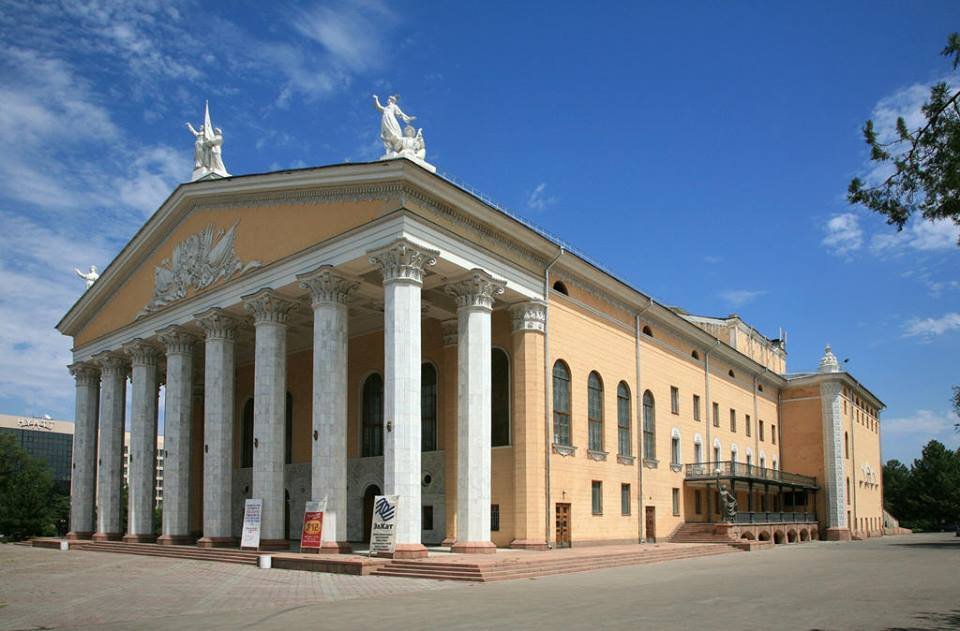
The Kyrgyz National Academic Opera and Ballet Theatre named after Abdylas Maldybaev is one of the most important cultural landmarks in Bishkek. The historic theatre combines monumental classical architecture with Kyrgyz artistic traditions and has played a central role in the development of professional opera, ballet and musical theatre in the country.
The present theatre building was completed in 1955 and is located in central Bishkek on Abdrahmanov Street. It remains one of the city’s most recognizable cultural buildings.
About the Opera and Ballet Theatre
The history of professional musical theatre in Kyrgyzstan began in the 1920s. A musical and dramatic studio was established in Frunze, the Soviet-era name of Bishkek, in 1926, followed by the establishment of the Kyrgyz State Theatre in 1930.
The theatre developed into an important center of musical culture, eventually becoming the national academic opera and ballet theatre.
The current building opened in 1955 and was designed by architects L. Laburenko and P. P. Ivanov.
At a Glance
Information | Details |
Type of Place | Architecture Complex |
Location | Central Bishkek |
Address | 167 Abdrahmanov Street |
Present building | Completed 1955 |
Architects | L. Laburenko and P. P. Ivanov |
Named after | Abdylas Maldybaev |
Status | National Academic Theatre |
Main functions | Opera, ballet and concerts |
Recommended time | 30–60 minutes |
Where Is the Opera and Ballet Theatre?
The theatre is located in central Bishkek at 167 Abdrahmanov Street.
Its position makes it easy to combine with several other central-city sights, including:
- Ala-Too Square
- Oak Park
- Open-Air Sculpture Museum
- Panfilov Park
- Erkindik Boulevard
- National Historical Museum
The theatre is particularly well suited to an architectural walking route through central Bishkek.
Architecture of the Theatre
The present theatre building was completed in 1955.
Its design is based on monumental classical architecture, with a large symmetrical facade, a prominent colonnade and a high pediment decorated with monumental sculptures. Sources describe the building as drawing on classical architectural traditions and incorporating Greek-inspired elements
The scale of the building reflects its original role as a major cultural institution in Soviet Frunze.
Sculptures and Decorative Art
The facade is decorated with monumental sculptures by Olga Manuilova.
Other artists contributed paintings, frescoes and decorative elements to the theatre’s interior. Historical descriptions mention the work of several prominent Kyrgyz and Soviet artists, making the building significant not only as a theatre but also as an example of monumental decorative art.
For visitors interested in architecture, the exterior itself is worth seeing even when they are not attending a performance.
History of the Theatre
Beginnings in the 1920s
The origins of the theatre go back to 1926, when the first musical and dramatic studio was established in Frunze.
The Kyrgyz State Theatre was established in 1930, and the institution gradually developed into a professional musical theatre.
Development of Opera and Ballet
During the 1930s, the theatre began producing musical dramas and increasingly developed its opera and ballet repertoire.
The 1937 musical drama Altyn Kyz, created with music by Vladimir Vlasov and Vladimir Fere and a libretto by Joomart Bokonbaev, was an important stage in this development.
In 1942, the musical and dramatic theatre was reorganized as the Kyrgyz State Theatre of Opera and Ballet.
The 1940s
The 1944 ballet Cholpon became an important production in the history of Kyrgyz ballet.
The production was associated with the rise of ballerina Bibisara Beishenalieva, who became one of the most prominent figures in Kyrgyz ballet.
The 1955 Theatre Building
Construction of the current theatre building began in the early 1950s.
The building was completed in 1955 with an auditorium designed to accommodate approximately 941 people.
The new building provided the growing opera and ballet institution with a permanent monumental home in the center of the capital.
Abdylas Maldybaev
The theatre has been named after Abdylas Maldybaev since 1978.
Maldybaev was a Kyrgyz composer, opera singer, actor, educator and public figure who played an important role in the development of professional musical culture in Kyrgyzstan.
His name is therefore closely connected with the history of Kyrgyz opera and musical theatre.
Academic and National Status
The theatre received the title Academic in 1959 in recognition of its contribution to theatrical arts.
In 2000, it received National status by presidential decree.
Its full name therefore reflects both designations:
Kyrgyz National Academic Opera and Ballet Theatre named after Abdylas Maldybaev.
Opera and Ballet Performances
The theatre continues to host opera and ballet performances, concerts and other cultural events.
The current programme changes regularly, so travelers interested in attending a performance should check the theatre’s current schedule before visiting.
How to Visit
The theatre can be visited as part of a central Bishkek sightseeing route.
There are two different visitor experiences:
Exterior visit:
See the architecture, colonnade, pediment and sculptures from the surrounding public areas.
Performance visit:
Purchase a ticket and attend an opera, ballet or concert when a suitable performance is scheduled.
The second experience requires checking the current programme and ticket availability.
Best Time to Visit
The exterior of the theatre can be seen throughout the year.
Spring and autumn are particularly comfortable for combining the theatre with a walking tour of central Bishkek.
For an evening cultural experience, visitors can combine sightseeing during the day with an opera or ballet performance if the current programme allows.
Practical Information
The theatre is an active cultural institution rather than a conventional museum.
Opening times and ticket arrangements depend on the current performance schedule.
For an exterior sightseeing stop:
Recommended time: 30–60 minutes.
For a performance:
Allow: approximately the duration of the scheduled production, plus time before and after the performance.
Visitors attending performances should check the current dress and photography rules.
Opera Theatre and Oak Park
The theatre stands near Oak Park and the Open-Air Sculpture Museum.
Places Near the Opera and Ballet Theatre
Relevant nearby Sights include:
- Oak Park
- Open-Air Sculpture Museum
- Ala-Too Square
- National Historical Museum
- Panfilov Park
- Erkindik Boulevard
- White House


