
Índice
ToggleArk Fortress Bukhara, Uzbekistan
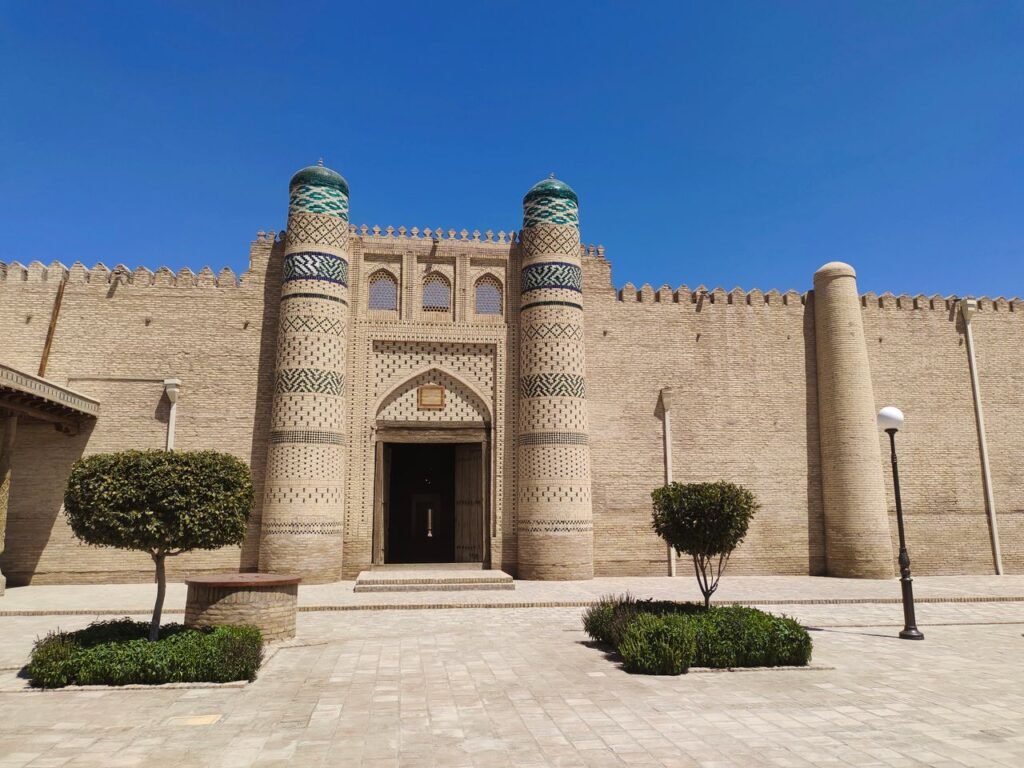
Ark Fortress in Bukhara, Uzbekistan, is one of the city’s most important historical landmarks and a remarkable symbol of its ancient political power. Rising above the surrounding historic streets, this massive citadel once served as the residence of Bukhara’s rulers and the administrative heart of the city.
Often called the Ark Citadel, the fortress has a history stretching back more than two thousand years. Archaeological evidence places its earliest foundations around the 4th–3rd centuries BCE, although the buildings visible today largely reflect later periods of reconstruction and development.
For centuries, the Ark functioned as a city within a city. Behind its imposing walls were royal residences, government offices, a treasury, military facilities, religious buildings, and living quarters for members of the court. Its elevated position and fortified design made it both a defensive stronghold and a powerful symbol of authority.
Today, Ark Fortress is one of the essential attractions for anyone visiting Bukhara. Its historic courtyards, royal reception hall, museum exhibitions, and surviving architectural features offer visitors an opportunity to discover the political, cultural, and social history of Uzbekistan.
Where Is Ark Fortress Located?
Ark Fortress is located in the historic center of Bukhara, in Uzbekistan’s Bukhara Region. It stands beside the historic Registan area, northwest of the old city’s central monuments.
The fortress occupies a raised artificial mound, giving it a commanding position above the surrounding streets. Its massive walls and monumental entrance make it one of the most recognizable landmarks in the city.
Bukhara’s historic center is recognized as a UNESCO World Heritage Site, celebrated for its important collection of Islamic architecture, historic trading domes, mosques, madrasas, and mausoleums.
Ark Fortress is easy to include in a walking tour of the city. Visitors can combine it with the Bolo Hauz Mosque, Poi Kalyan Complex, Lyabi-Hauz, and the Samanid Mausoleum, depending on the time available.
History of Ark Fortress Bukhara
The history of Ark Fortress reflects the long development of Bukhara as an important political, cultural, and commercial center in Central Asia.
Archaeological research places the earliest foundations of the citadel around the 4th–3rd centuries BCE. Over the centuries, the fortress was repeatedly damaged, rebuilt, and expanded by successive rulers.
During the early medieval period, the Ark became an important seat of authority for the rulers of Bukhara. It developed into a fortified complex containing palaces, administrative buildings, religious structures, and other facilities required to govern the surrounding region.
The fortress underwent major changes under different dynasties. During the Samanid period, between the 9th and 10th centuries, Bukhara became a major center of Islamic scholarship and culture. The Ark remained closely associated with the city’s ruling elite.
Its present general form developed significantly under the Shaybanid dynasty during the 16th century, although individual buildings were subsequently reconstructed or added.
In later centuries, the fortress continued to serve as the residence and administrative center of Bukhara’s rulers, including the emirs of the Emirate of Bukhara.
The Ark in the Time of the Emirs
By the 19th and early 20th centuries, Ark Fortress functioned as the center of the emir’s government. It housed the ruler’s residence, court officials, administrative offices, military facilities, and other essential institutions.
The complex was designed to accommodate many aspects of court life within its fortified boundaries. Its courtyards and buildings provided spaces for official audiences, religious activities, administration, and domestic life.
The fortress was therefore much more than a defensive structure. It represented the political authority of Bukhara’s rulers and served as the heart of the emirate’s administration.
The Destruction of 1920
A major turning point in the history of Ark Fortress occurred in 1920, when military operations against the Emirate of Bukhara caused extensive destruction to the complex.
Large sections of the fortress were damaged or destroyed, leaving only part of the historic buildings intact. The destruction dramatically changed the appearance of the citadel and ended its role as the active residence of Bukhara’s rulers.
Despite these losses, surviving structures preserve important evidence of the city’s architectural and political past.
Ark Fortress as a Museum Today
Since 1947, the fortress has been associated with the Bukhara State Museum-Reserve. Its surviving buildings and exhibition spaces help visitors explore the region’s history, archaeology, natural environment, and cultural traditions.
The museum displays provide a broader understanding of Bukhara’s development, from its ancient origins to its role as a major center of scholarship, trade, and government.
Visiting the Ark today allows travelers to explore both the remaining architecture and the historical collections housed within the citadel.
Architecture of Ark Fortress
Ark Fortress is an impressive example of traditional Central Asian defensive architecture. Its massive walls, raised foundations, monumental entrance, and interconnected courtyards reflect the practical and symbolic functions of a royal citadel.
The fortress covers approximately four hectares and has walls that rise roughly 16–20 meters above the surrounding ground in places. The enclosing walls form an irregular polygon, giving the complex its distinctive outline.
The architecture combines defensive features with buildings designed for court ceremonies, religious activities, administration, and daily life.
1. The Monumental Entrance
The main entrance is one of the fortress’s most recognizable architectural features. Visitors approach it along a raised ramp known as the takhtapul, which leads toward the imposing gateway.
The entrance is flanked by substantial walls and towers, creating a strong impression of security and authority.
Historically, the approach helped control access to the citadel. Its design also emphasized the elevated position of the ruler’s residence above the surrounding city.
Today, the entrance provides a dramatic introduction to the fortress and is a popular location for architectural photography.
2. The Royal Throne Room – Kurinish Khana
The Kurinish Khana, or royal reception hall, is among the most important surviving spaces within Ark Fortress.
This area was used for official audiences and ceremonies involving the ruler, government officials, and other visitors. Its layout reflects the formal traditions of the royal court.
The reception area includes a courtyard and covered spaces that were used for ceremonial purposes. Decorative details and traditional architectural elements help visitors imagine the formal activities that once took place here.
The throne room is particularly valuable for understanding the political functions of the citadel and the relationship between architecture and royal authority.
3. Jome Mosque
The Jome Mosque within the fortress served the religious needs of the ruler and the royal household.
Its presence illustrates how religious life was integrated into the political and administrative center of Bukhara. Mosques within royal complexes provided spaces for prayer and reinforced the connection between Islamic traditions and governance.
The surviving architectural elements contribute to the broader picture of daily life within the citadel.
4. The Kushbegi Courtyard
The Kushbegi area was associated with the chief minister and important administrative functions of the emirate.
Government officials worked within the fortress, managing affairs of state and supporting the ruler’s administration. The courtyard and surrounding spaces demonstrate the importance of organized government within the citadel.
This section helps visitors understand why Ark Fortress was considered a city within a city rather than simply a royal residence.
5. Defensive Walls and Raised Foundations
The fortress’s high walls and raised mound are among its most distinctive features. The elevated foundations made the citadel visible from the surrounding area and helped strengthen its defensive position.
The walls were repeatedly repaired and rebuilt over the centuries. Their surviving sections reveal the scale of the engineering effort required to maintain such an important stronghold.
The contrast between the massive exterior walls and the more intimate spaces inside is an important part of the visitor experience.
Why Is Ark Fortress Famous?
Ark Fortress is one of Bukhara’s most significant historical attractions for several reasons.
1. Ancient origins: Archaeological evidence places the earliest foundations of the citadel around the 4th–3rd centuries BCE.
2. Royal residence: The fortress served as the residence and administrative center of Bukhara’s rulers for many centuries.
3. A city within a city: Its walls enclosed palaces, offices, religious buildings, military facilities, and living quarters.
4. The royal throne room: The Kurinish Khana provides insight into the ceremonial life of the rulers.
5. Impressive defensive architecture: Its raised mound and high walls make the fortress a distinctive feature of Bukhara’s historic skyline.
6. Historical museum: The surviving complex houses museum exhibitions that help explain Bukhara’s long history and cultural heritage.
7. A connection to famous scholars: Historical traditions associate Bukhara and its ruling environment with notable intellectual figures, including Avicenna and Omar Khayyam. Specific claims about their residence within the Ark should be treated carefully because historical accounts vary.
Together, these features make Ark Fortress an essential destination for travelers interested in the history of Central Asia.
The Legend of Siyavush and Ark Fortress
Like many ancient monuments in Uzbekistan, Ark Fortress is surrounded by local legends.
One of the best-known stories concerns Siyavush, a legendary prince who supposedly sought to marry the daughter of Afrasiab, the ruler of a legendary kingdom.
According to the story, Afrasiab agreed to the marriage only if Siyavush could build a fortress on a piece of land covered by a bull’s hide. Siyavush cleverly cut the hide into thin strips and joined them together to create a much larger outline, allowing him to define the ground for the fortress.
The legend explains the extraordinary origins of the citadel and reflects the imaginative traditions associated with Bukhara’s ancient past.
However, this story belongs to local folklore rather than established archaeological history. The actual development of Ark Fortress took place over many centuries through repeated construction, destruction, and rebuilding.
The legend remains a memorable part of the cultural stories surrounding Bukhara and adds another dimension to a visit.
Best Time to Visit Ark Fortress
Spring and autumn are generally the most comfortable seasons for exploring Bukhara. Temperatures are often suitable for walking between historic monuments and spending time outdoors.
Early morning can be a good choice for visitors who prefer a quieter atmosphere. It also provides opportunities to photograph the fortress walls in softer natural light.
Late afternoon is another attractive time to appreciate the structure’s elevated position and the surrounding historic streets.
Summer can be extremely hot, so carry water, wear sun protection, and plan outdoor sightseeing for cooler hours. Winter visits may be quieter, although temperatures can be cold.
Allow sufficient time to explore the museum exhibitions and surviving structures inside the fortress rather than stopping only at the entrance.
Things to See Near Ark Fortress
Ark Fortress is surrounded by several important historical attractions in Bukhara. These sites can be combined into a walking tour of the city’s historic center.
1. Bolo Hauz Mosque
Located near Ark Fortress, Bolo Hauz Mosque is famous for its elegant wooden columns and decorative entrance. Its beautiful veranda and traditional architecture make it one of the most photogenic religious buildings in Bukhara.
2. Poi Kalyan Complex
Poi Kalyan is one of Bukhara’s most celebrated architectural ensembles. It includes the Kalyan Minaret, Kalyan Mosque, and Mir-i-Arab Madrasa, representing different aspects of the city’s religious and architectural heritage.
3. Lyabi-Hauz Ensemble
Lyabi-Hauz is a historic square centered around an old reservoir. Surrounded by traditional buildings, madrasas, and places to relax, it provides a pleasant contrast to the monumental architecture of Ark Fortress.
4. Samanid Mausoleum
The Samanid Mausoleum is a remarkable example of early Islamic architecture in Central Asia. Its intricate brickwork and geometric patterns make it one of Bukhara’s most important historic monuments.
5. Chor Minor
Chor Minor is known for its unusual building design and four distinctive towers. Its compact size and architectural character make it a popular stop for visitors exploring Bukhara beyond the main monumental complexes.
6. Historic Trading Domes
Bukhara’s traditional covered bazaars once played an important role in the city’s commercial life along regional Silk Road routes. The surviving trading domes provide a glimpse into the architecture of historic commerce and craftsmanship.
Travel Tips for Visiting Ark Fortress
To make the most of your visit, consider the following recommendations:
Wear comfortable shoes: The fortress includes courtyards and historic surfaces that require walking.
Allow time for the museum: The exhibitions provide valuable context for the buildings and Bukhara’s history.
Bring a camera: The monumental entrance, raised walls, and historic courtyards offer excellent photography opportunities.
Visit in comfortable weather: Spring and autumn are generally pleasant seasons for sightseeing.
Explore nearby attractions: Combine the fortress with Bolo Hauz Mosque and other historic sites.
Check opening hours and ticket prices: Admission arrangements can change, so verify the latest information before visiting.
Consider a local guide: A guide can explain the fortress’s changing role across different dynasties.
Respect historic structures: Follow museum instructions and avoid touching fragile architectural surfaces.
If you are particularly interested in the history of Bukhara, allow additional time for the museum exhibitions and the surviving royal and administrative spaces.
Ark Fortress Bukhara Information Table
| Característica | Detalles |
|---|---|
| Nombre | Fortaleza Ark |
| Alternative names | Ark Citadel, Ark Fortress of Bukhara |
| Ubicación | Historic center of Bukhara, Uzbekistan |
| Región | Bukhara Region |
| Earliest archaeological origins | Commonly dated to the 4th–3rd centuries BCE |
| Historical role | Royal residence, administrative center, and defensive citadel |
| Main development | Multiple periods of rebuilding; major form developed by the 16th century |
| Área aproximada | Around 4 hectares |
| Wall height | Approximately 16–20 meters |
| Architectural features | Raised mound, massive walls, monumental entrance, courtyards |
| Notable building | Kurinish Khana royal reception hall |
| Major historical event | Extensive destruction in 1920 |
| Museum association | Bukhara State Museum-Reserve |
| Nearby landmark | Mezquita Bolo Hauz |
| Historic setting | Historic center of Bukhara, a UNESCO World Heritage Site |
| Recommended visit duration | Approximately 1–2 hours |
Dates and measurements are approximate and vary slightly among heritage sources. The fortress developed over many centuries, so its archaeological origins should not be confused with the dates of its surviving buildings.


