
Table of Contents
ToggleUzgen: Historical Complex, Kyrgyzstan
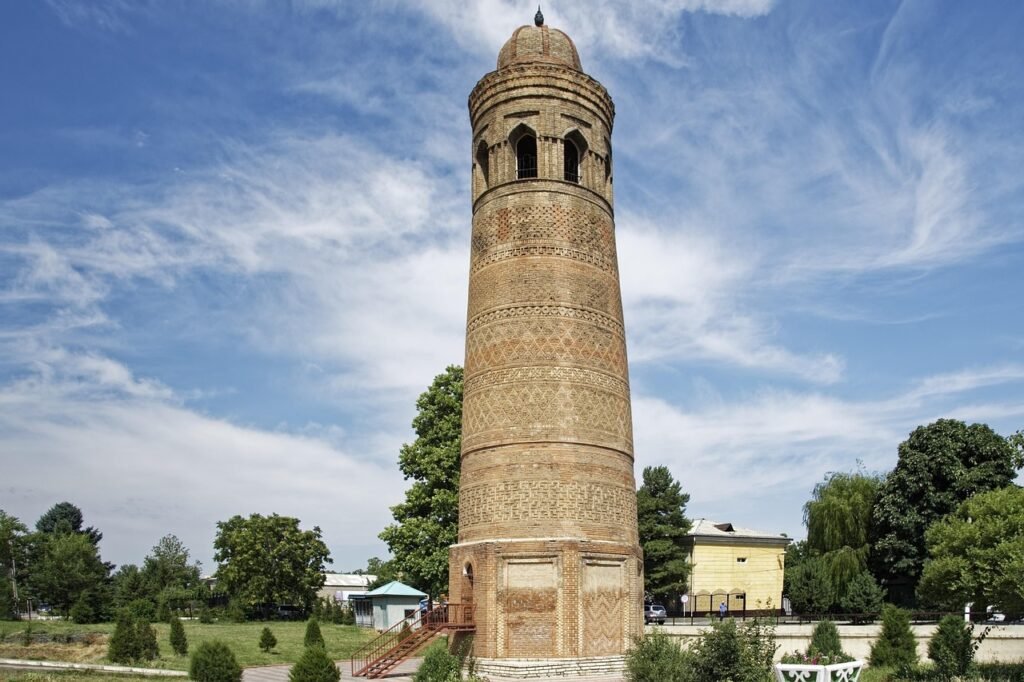
The Uzgen Historical Complex is one of the most important medieval architectural monuments in southern Kyrgyzstan. Located in the center of Uzgen in Osh Region, the complex is best known for its Karakhanid-era minaret and three mausoleums decorated with intricate brickwork, carved terracotta and inscriptions.
Uzgen developed as an important city on the historic Silk Road and became a major center of the Karakhanid state. Today, the architectural complex provides a glimpse into the history and architecture of medieval Central Asia.
About Uzgen Historical Complex
The complex dates mainly from the 11th and 12th centuries, during the period of Karakhanid rule.
Its best-known monuments are:
- Uzgen Minaret
- Northern Mausoleum
- Middle Mausoleum
- Southern Mausoleum
The monuments stand close together in the center of modern Uzgen. The wider historical area also contains archaeological remains of the medieval city, including its citadel and three shahristans.
Uzgen Historical Complex at a Glance
Information | Details |
Type of Place | Architecture Complex |
Country | Kyrgyzstan |
Region | Osh Region |
Nearest City | Uzgen |
Historical Period | Mainly 11th–12th centuries |
Main Dynasty | Karakhanids |
Main Monuments | Minaret and three mausoleums |
Historical Role | Silk Road city and Karakhanid center |
Recommended Visit | 2-4 hours |
Best Time | Spring to autumn |
Where Is Uzgen Historical Complex?
The complex is located in the center of Uzgen, on the Kara-Darya River in southern Kyrgyzstan.
Uzgen lies northeast of Osh and can be visited as a historical excursion from Osh or as a stop on a wider journey through the Fergana Valley and southern Kyrgyzstan.
The monuments are integrated into the modern city rather than being located in a remote archaeological park.
History of Uzgen
Uzgen grew on an important historical route connecting the Fergana Valley with other parts of Central Asia.
During the 10th–13th centuries, the city became an important political, commercial and cultural center of the Karakhanid state. Sources identify Uzgen as a major trading center and one of the capitals of the western Karakhanid realm.
The medieval settlement consisted of a fortified citadel and several shahristans. Archaeological remains of these urban areas form part of the wider Uzgen historical heritage.
The Uzgen Minaret
The Uzgen Minaret is the most recognizable monument in the complex.
It was built in the 11th century and is constructed primarily from fired brick. Its design includes an octagonal base and a tapering shaft decorated with patterned brickwork.
The surviving monument is approximately 27 meters high. The upper lantern-like section was added in the 1920s after the original upper portion had been lost.
The minaret is architecturally related to the broader tradition of Karakhanid monumental architecture seen elsewhere in Kyrgyzstan, including the Burana Tower.
The Three Mausoleums
Three mausoleums stand beside the minaret.
Middle Mausoleum
The middle mausoleum is considered the earliest of the three main mausoleums.
Its architecture and decoration provide an example of early Karakhanid funerary architecture.
Northern Mausoleum
The northern mausoleum was constructed in the 12th century. Its facade contains elaborate decorative elements, inscriptions and carved terracotta.
A date corresponding to 1152 appears in its decorative inscriptions.
Southern Mausoleum
The southern mausoleum is generally dated to 1187, based on its surviving inscription.
Its portal is particularly notable for its carved terracotta decoration and geometric and floral ornament.
Karakhanid Architecture
The Uzgen complex is particularly valuable for its architectural decoration.
The buildings combine:
- Fired-brick construction
- Carved terracotta
- Decorative plaster
- Geometric patterns
- Floral ornament
- Arabic inscriptions
- Elaborate portal decoration
UNESCO describes the complex as demonstrating the development of domed and portal architecture during the pre-Mongol period.
The decorative program is especially important because it preserves examples of the artistic traditions associated with the Karakhanid period.
Uzgen and the Silk Road
Uzgen developed along historic trade routes through the Fergana region.
Its location helped connect commercial and cultural networks between the Fergana Valley and other parts of Central Asia.
The city’s medieval importance explains why such a substantial architectural complex developed here. UNESCO’s tentative-list documentation identifies Uzgen as an important Silk Road connection and describes the city as having sustained political, economic, trading and cultural contacts over centuries.
The Medieval City of Uzgen
The minaret and mausoleums are only part of Uzgen’s historical heritage.
The broader archaeological complex includes the remains of:
- The medieval citadel
- Three shahristans
- Ancient urban areas
- Former religious and civic structures
- Archaeological remains associated with medieval Uzgen
In 2022, the Kyrgyz government established the Uzgen State Historical and Cultural Museum-Reserve to help preserve and develop the area’s historical and cultural monuments.
For the Doctour Sight page, however, the main visitor focus should remain the minaret and mausoleums. The wider archaeological history can be covered without turning the page into a complete archaeological survey.
What to See
A typical visit can focus on:
- Uzgen Minaret
- Three Karakhanid mausoleums
- Decorative brick and terracotta work
- Arabic inscriptions
- Remains of medieval Uzgen
- The surrounding historic center of the city
Allow approximately 2-4 hours if you want to see the complex together with some of the surrounding city.
How to Visit Uzgen Historical Complex
From Osh
Uzgen is close enough to Osh for a half-day or full-day historical excursion.
This makes the complex particularly suitable for travelers staying in Osh who want to explore the historical heritage of southern Kyrgyzstan.
From Jalal-Abad
Uzgen can also be included in a road journey between Osh, Jalal-Abad and other destinations in the Fergana Valley.
By Tour
A guided excursion can combine Uzgen with other southern Kyrgyzstan attractions.
Depending on the itinerary, possible combinations include:
- Osh
- Uzgen
- Jalal-Abad
- Arslanbob
- Fergana Valley attractions
Best Time to Visit
Spring and Autumn
Spring and autumn generally provide more comfortable temperatures for exploring the historic center and surrounding city.
Summer
Summer is suitable for sightseeing, but temperatures in the Fergana Valley can be high. An early start is more comfortable.
Winter
The monuments can still be visited during winter, although the weather is less favorable for combining the site with longer outdoor excursions.
Practical Information
The complex is located within the city, so visiting Uzgen is considerably easier than reaching remote mountain sights.
For your visit:
- Wear comfortable shoes.
- Allow several hours if exploring the wider historic area.
- Bring water during hot weather.
- Respect the monuments and any restricted areas.
- If visiting as part of a guided tour, allow time for explanations of the architectural details and inscriptions.
Opening hours, entrance arrangements, and museum access can change, so these details should be confirmed locally before publication as fixed information on the website.


