
Inhaltsverzeichnis
UmschaltenVictory Square in Bishkek, Kyrgyzstan
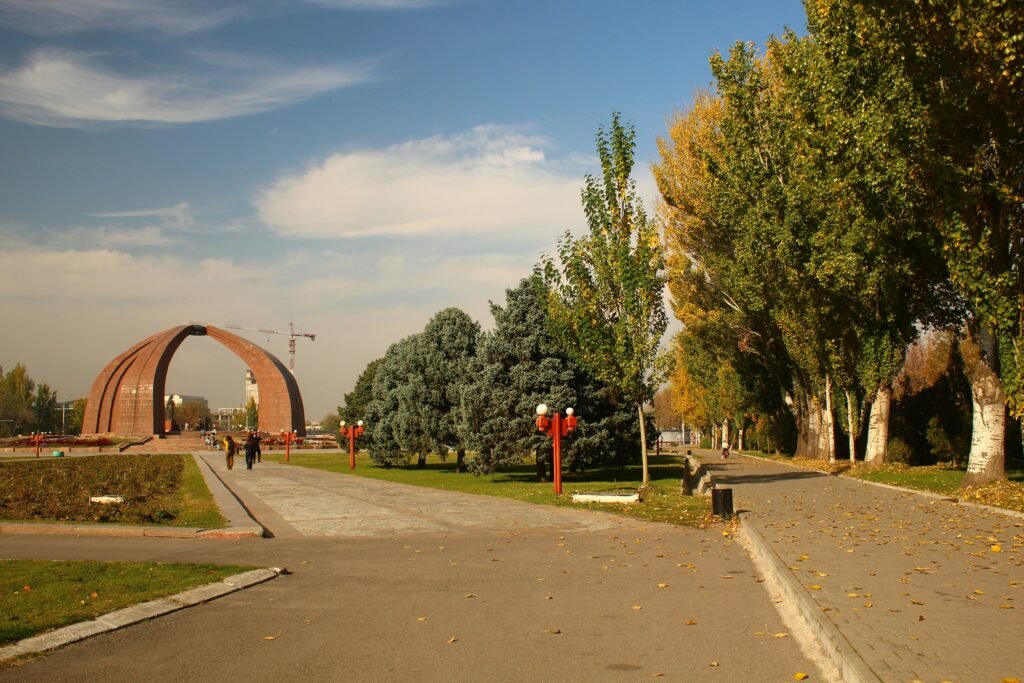
Victory Square is one of the main memorial landmarks in Bischkek, Kyrgyzstan. Known locally as Ploshchad Pobedy, the square commemorates the victory in the Second World War and those who died during the war.
The centerpiece is the Victory Monument, built in 1985 for the 40th anniversary of the end of the war. Its distinctive three granite arches form a stylized Kyrgyz yurt over an Eternal Flame, creating one of the most recognizable memorials in Bishkek.
About Victory Square
Victory Square is a public memorial square in central Bishkek.
The square was created in 1985, during the 40th anniversary commemorations of the end of the Second World War. The memorial combines Soviet monumental architecture with traditional Kyrgyz imagery, particularly the form of the tunduk, the crown-like structure at the top of a Kyrgyz yurt.
Today, the square remains an important place for remembrance ceremonies and Victory Day events.
Auf einen Blick
Information | Details |
Art des Ortes | Stadt |
Ort | Zentrum Bischkek |
Kyrgyz name | Жеңиш аянты |
Russian name | Площадь Победы |
Created | 1985 |
Hauptwahrzeichen | Siegesdenkmal |
Memorial feature | Eternal Flame |
Hauptthema | Remembrance of the Second World War |
Empfohlene Zeit | 30–45 minutes |
Best combined with | Central Bishkek sightseeing |
Where Is Victory Square?
Victory Square is located in central Bishkek, within walking distance of several important city landmarks.
Nearby attractions include:
- Oak Park
- Freiluft-Skulpturenmuseum
- Ala-Too-Platz
- Nationales Historisches Museum
- Chuy Avenue
- Bishkek Circus
This makes Victory Square easy to include in a broader city sightseeing itinerary.
The Victory Monument
The main attraction of Victory Square is the Victory Monument.
The monument was installed in 1985 and consists of three large curved granite structures rising above the Eternal Flame. The three arches are designed to evoke the frame of a traditional Kyrgyz yurt.
At the center of the memorial is a sculpture representing a woman waiting for her husband and family members to return from the war.
The composition combines a memorial to wartime loss with traditional Kyrgyz visual symbolism.
The Eternal Flame
The Eternal Flame is located beneath the central structure of the monument.
It is the focal point of the memorial and is used during commemorative ceremonies and wreath-laying events.
The flame is particularly important on 9 May, Victory Day, when official remembrance ceremonies take place at the square. In May 2026, a memorial ceremony and military procession were held at Victory Square to mark the 81st anniversary of Victory.
The Woman Waiting for the Soldiers
One of the most recognizable elements of the monument is the sculpture of a woman standing beneath the tunduk-like structure.
The figure represents women waiting for their husbands, sons and other family members to return from the war.
The composition gives the memorial a distinctly human dimension rather than presenting only military imagery.
Kyrgyz Yurt Symbolism
The architecture of the Victory Monument incorporates one of the most recognizable symbols of Kyrgyz culture: the yurt.
The three curved granite arches represent the structural form of a yurt, while the circular tunduk at the top is another important Kyrgyz cultural symbol.
This combination makes the monument particularly interesting from an architectural and cultural perspective.
History of Victory Square
Before the present memorial square was created, the area was associated with Bishkek’s former Green Market.
The Green Market, also known as the Kolkhozny Market, was established in 1929 and occupied a substantial area of the city. It was later moved as Bishkek expanded.
The present Victory Square and monument were created in 1985 as part of the 40th-anniversary commemorations.
Victory Square Today
Victory Square continues to function as a public memorial space.
It is used for:
- Victory Day commemorations
- wreath-laying ceremonies
- remembrance events
- public gatherings
- cultural and historical sightseeing
The square is therefore both a tourist landmark and an active memorial site.
Victory Day in Bishkek
Victory Day is observed on 9 May.
Victory Square is one of the principal locations for official commemorations in Bishkek. In 2026, senior government officials participated in a memorial ceremony at the square and laid flowers at the Eternal Flame.
Travelers visiting around 9 May may therefore encounter ceremonies, military formations, temporary installations or increased visitor numbers.
How to Visit Victory Square
Victory Square can be visited independently or as part of a central Bishkek walking tour.
A useful sightseeing route is: Victory Square – Oak Park – Open-Air Sculpture Museum – Ala-Too Square – Nationales Historisches Museum.
Alternatively, it can be combined with the nearby Bishkek Circus and other central-city landmarks.
The square is a public outdoor space, so visitors do not need to allocate several hours for the visit.
Beste Reisezeit
Victory Square can be visited throughout the year.
Spring and autumn are comfortable seasons for walking around central Bishkek. Summer is also suitable, although temperatures can be high during the middle of the day.
The square can be especially meaningful to visit around 9 May, although this is also when ceremonies and crowds are more likely.
For a quieter experience, visit outside major commemorative events.
Praktische Informationen
Victory Square is an open public space.
Empfohlene Zeit: 30–45 minutes.
Entrance: No regular entrance ticket is required.
Am besten geeignet für: history, memorial architecture, photography and central Bishkek sightseeing.
Visitors should behave respectfully around the Eternal Flame and memorial sculptures, particularly during official ceremonies.
Victory Square and Bishkek’s Soviet Architecture
The Victory Monument is an example of late Soviet monumental design adapted to local Kyrgyz symbolism.
It is therefore useful to view Victory Square alongside other Soviet-era landmarks in Bishkek, including Ala-Too-Platz and the White House.


