
Table of Contents
ToggleWhite House in Bishkek, Kyrgyzstan
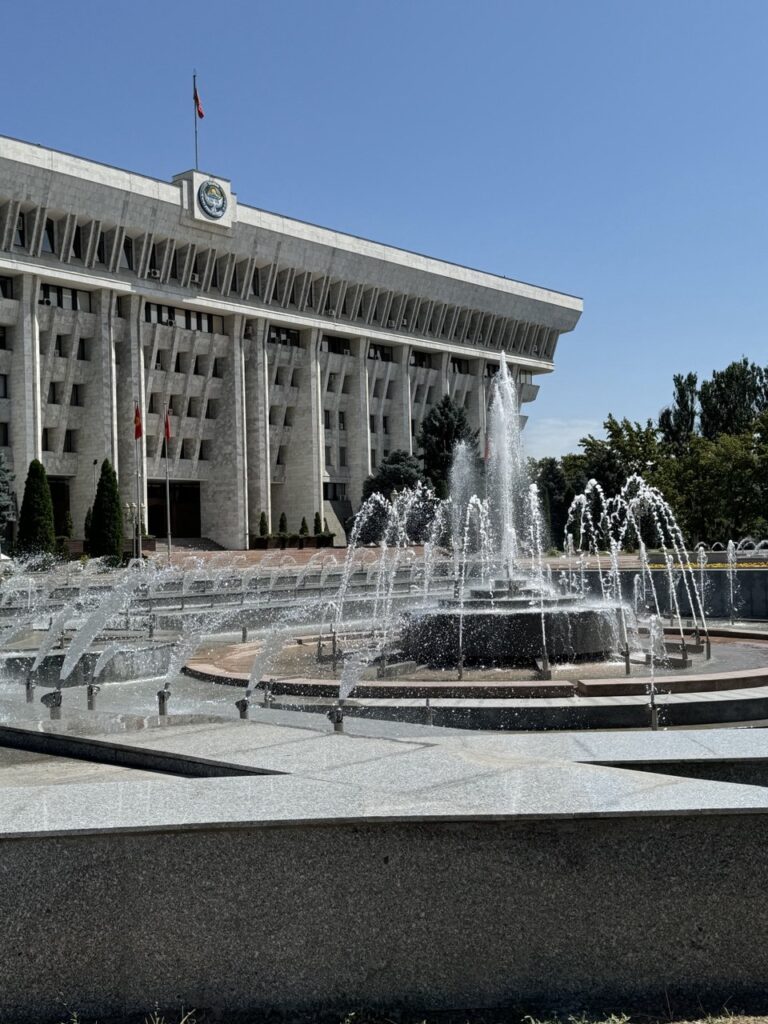
The White House is one of the most recognizable government buildings in Bishkek and an important landmark of the capital’s Soviet and post-Soviet history. The large marble-clad building stands beside Ala-Too Square and has played an important role in the political history of independent Kyrgyzstan.
Built in the late Soviet period, the White House was originally designed as the headquarters of the Communist Party’s Central Committee and became one of the defining buildings of central Bishkek.
For travelers, the building is primarily an exterior landmark that can be viewed as part of a central Bishkek walking route.
About the White House
The White House is a large seven-story administrative building located on Chuy Avenue in central Bishkek.
Construction began in the late 1970s, and the building was completed in the mid-1980s. It was designed as a major administrative headquarters during the Soviet period.
Its monumental scale, marble exterior and prominent position beside Ala-Too Square make it one of the most recognizable examples of late Soviet architecture in Bishkek.
At a Glance
Information | Details |
Type of Place | Architecture Complex |
Location | Central Bishkek |
Address | 205 Chuy Avenue |
Construction | Late 1970s–mid-1980s |
Completed | 1985 |
Architecture | Soviet monumental / modernist architecture |
Height | 7 storeys |
Exterior | Marble-clad |
Main nearby sight | Ala-Too Square |
Recommended time | 15–30 minutes |
Where Is the White House?
The White House is located on Chuy Avenue in central Bishkek, immediately adjacent to the Ala-Too Square area.
Its location makes it easy to see together with several of the city’s main attractions.
A convenient sightseeing route can include:
Ala-Too Square → White House → National Historical Museum → Oak Park → Open-Air Sculpture Museum
Architecture of the White House
The White House is a monumental seven-story building faced with marble.
Its design belongs to the large-scale Soviet architectural tradition of the late 20th century, combining a massive symmetrical form with monumental detailing. Sources describe its architectural inspiration as related to Soviet government architecture, including the former Gosplan building in Moscow.
The building was designed by architects working at Frunzegorproekt, the architectural organization responsible for major projects in Soviet Frunze, the former name of Bishkek.
For visitors interested in architecture, the White House is particularly useful for understanding the scale and character of Soviet-era central Bishkek.
History of the White House
The building was constructed during the final decades of the Soviet Union.
It was commissioned as the headquarters of the Central Committee of the Communist Party of the Kirghiz Soviet Socialist Republic and other major republican administrative functions. Construction was completed in 1985.
After Kyrgyzstan became independent in 1991, the building continued to serve as one of the country’s principal government buildings.
The building has therefore remained closely connected with the country’s political and institutional history.
The White House and Kyrgyzstan’s Independence
The White House has particular historical significance because of its connection with major political changes in Kyrgyzstan.
During the transition from the Soviet period to independence, the building was associated with the country’s central government institutions. The early independent parliament also used the building before later moving to other premises and subsequently returning.
This history makes the White House more than simply an example of Soviet architecture: it is also a landmark connected with the formation of modern Kyrgyzstan.
White House and Modern Kyrgyz History
The building became a major focal point during several periods of political unrest in Kyrgyzstan, including the events of 2005, 2010 and 2020. The building was damaged by fire during the 2010 unrest, and it was again affected by events in 2020.
For a tourism page, this history is best presented as concise historical context rather than turning the Sight into a detailed political-history article.
What Can Visitors See?
The White House is primarily an exterior sightseeing landmark.
Visitors can appreciate:
- the monumental marble facade
- the scale of the seven-story building
- Soviet-era architectural design
- its relationship with Ala-Too Square
- the surrounding central Bishkek streets
- nearby monuments and government buildings
Access to government interiors should not be assumed. The page should focus on what travelers can actually experience from public areas.
How to Visit the White House
The White House is located in central Bishkek and can easily be included in a walking tour.
The easiest approach is to visit it together with Ala-Too Square and the nearby National Historical Museum.
A compact central Bishkek route could be:
- Ala-Too Square
- White House
- National Historical Museum
- Oak Park
- Open-Air Sculpture Museum
- Erkindik Boulevard
This creates a natural cluster of your existing Sight pages without requiring a separate “Bishkek Architecture” category.
Best Time to Visit
The White House can be viewed throughout the year.
Spring and autumn are particularly comfortable for walking around central Bishkek. Summer is also suitable, although the large open areas around Ala-Too Square can become hot during the middle of the day.
Morning and late afternoon are generally convenient for combining the White House with other central-city sights.
Practical Information
The White House is a functioning government building rather than a conventional museum or tourist attraction.
Recommended time: 15–30 minutes.
Entrance: Do not assume tourist access to the interior.
Best experience: View the building from public areas and combine it with Ala-Too Square and the National Historical Museum.
Visitors should follow any security instructions and avoid attempting to enter restricted areas.
White House and Soviet Bishkek
The White House is particularly useful for visitors interested in the architectural transformation of Bishkek during the Soviet period.
Together with Ala-Too Square and the National Historical Museum, it forms part of a monumental urban ensemble created during the 1980s.
Other examples of Soviet-era architecture can be found throughout central Bishkek, but there is no need to create a separate “Soviet Architecture of Bishkek” Sight page at this stage.


